
D-Wave Quantum (NYSE: QBTS) may be one of the most misunderstood stocks in the market today. To most retail investors, D-Wave Quantum looks like another speculative tech name riding the hype cycle. That is, a volatile, money-losing small-cap that briefly exploded from $5 to $12 and has since spent months unwinding.
Table of Contents
That reading isn’t wrong. But it isn’t the full story either. For investors with a genuine long-term time horizon and a tolerance for risk, D-Wave deserves a closer look. That’s not because the near-term picture is clean, but because the company occupies a uniquely defensible position at the frontier of what may be the most consequential computing revolution in history.
Quantum computing is not artificial intelligence. It is not a new software framework or a faster chip. It is a fundamentally different way of processing information, and one that experts believe will eventually make the AI boom look like a prelude.
Quantum Computing: The Technology Wall Street Is Just Beginning to Understand
To appreciate what D-Wave is building, it helps to understand why quantum computing is more than AI 2.0.
Classical computers, from your phone to the most powerful data centers on earth, process information as binary bits, each one a 0 or a 1. Every AI model, every algorithm, every cloud application ultimately reduces to vast chains of those binary choices. AI has proven extraordinarily powerful at pattern recognition and prediction built on this architecture. However, it’s still constrained by the same fundamental limits as every computer built since the 1940s.
Quantum computers break those limits. They use quantum bits, or qubits, which, through a property called superposition, can exist as 0, 1, or any combination of both states simultaneously. Entanglement allows qubits to become correlated so that the state of one instantly influences another. The result is a machine that can explore enormous numbers of potential solutions in parallel. Not one path at a time, but an entire landscape of possibilities at once.
This is not an incremental improvement. For specific categories of problems — molecular simulation, optimization across thousands of variables, cryptographic analysis, complex financial modeling — quantum computers do not simply run faster than classical machines. They solve problems that classical machines cannot solve at all, regardless of how many chips or GPU clusters you deploy. That distinction matters enormously for investors. AI accelerates what we can already compute. Quantum computing unlocks what we currently cannot.
Risks and Rewards
The potential upside is staggering, and so are the risks on both sides of the ledger.
On the positive side, drug discovery stands out as perhaps the most near-term and high-value application. Developing a single new drug currently costs $1–3 billion and takes a decade, with only a roughly 10% success rate. The bottleneck is computational: accurately simulating how a drug molecule interacts with a biological target requires modeling quantum-level electron interactions that classical computers can only approximate.
Quantum computers handle these simulations natively. Early results from pharmaceutical partnerships are already demonstrating that quantum-enhanced systems can generate superior drug candidates in a fraction of the time required by purely classical or AI-based methods. Beyond pharma, the implications extend to climate modeling, materials science, logistics optimization, and financial risk management.
On the negative side, the same capabilities pose a genuine threat to existing digital infrastructure. Encryption standards underlying Bitcoin, global banking, and internet communications rely on mathematical problems that quantum computers — once sufficiently powerful — could theoretically solve. This “harvest now, decrypt later” risk, where adversaries store encrypted data today to decrypt once quantum hardware matures, is already being taken seriously by governments and financial institutions.
The U.S. National Institute of Standards and Technology (NIST) has finalized a suite of quantum-resistant cryptographic standards. The transition will be costly and disruptive — and represents both a risk for holders of cryptocurrency and a significant opportunity for companies positioned to help the world re-encrypt itself.
D-Wave: The Specialized Approach That May Give It an Edge
D-Wave is not trying to build a general-purpose quantum computer. That distinction, which is often glossed over in breathless quantum coverage, is crucial to understanding why the company may be better positioned than its competitors for near-term commercial success.
Where rivals like IonQ and IBM are pursuing gate-model quantum systems designed to eventually handle any quantum computation, D-Wave has focused on a technique called quantum annealing. Annealing systems identify the lowest-energy state in a problem space, which corresponds to the optimal solution. As it turns out, optimization problems (i.e., finding the best route, the most efficient schedule, the ideal molecular structure) represent the overwhelming majority of real-world tasks where quantum computing is expected to deliver commercial value in the near term.
This focused architecture has allowed D-Wave to leapfrog the competition where it matters most right now: paying customers. The company is the world’s first commercial quantum computing supplier, with over 100 enterprise clients running live production applications on its Advantage cloud platform today, not in pilot programs or proofs of concept.
The commercial results are beginning to reflect that traction. Revenue surged 235% through the first three quarters of 2025, and first-quarter 2026 bookings alone exceeded $32.8 million as of late February. Analysts project $39.5 million in full-year 2026 revenue.
In January 2026, D-Wave executed arguably its most strategic move yet: a $550 million acquisition of Quantum Circuits Inc. (QCI), a developer of error-corrected superconducting gate-model quantum systems whose dual-rail qubit technology achieves gate fidelities above 99.9%. The combined entity is now positioned to deliver both the best commercial annealing platform available today and fault-tolerant gate-model systems as the technology matures — a dual strategy that no competitor currently matches.
Why D-Wave May Be a Long-Term Hold
The investment case for QBTS is not about next quarter’s earnings. The company continues to operate at a loss, revenue is still in the tens of millions, and the valuation reflects years of expected growth already baked in. None of that is unusual for a platform company in the early innings of a technology cycle.
What makes D-Wave compelling as a long-term hold is the combination of factors it has assembled: the only company generating meaningful commercial quantum computing revenue today, a growing enterprise customer base across industries where quantum optimization delivers measurable ROI now, a proprietary annealing platform with a decade-long head start on the competition, and, following the QCI acquisition, a credible path to full-scale error-corrected gate-model quantum computing.
The quantum computing market is projected to grow from roughly $1.5 billion today to $450–850 billion over the next two decades. D-Wave is the only publicly traded pure-play company in that market with a working commercial business underneath the hype. That combination of existing revenue and frontier technology positioning is rare — and it is the core reason long-term investors are paying attention.
Why Insider Selling Isn’t the Red Flag It Appears to Be
Insider selling at QBTS has made headlines, and it deserves a clear-eyed look. CEO Alan Baratz sold 793,712 shares in December 2025, and CFO John Markovich sold 100,000 shares in the same period. Additional sales by other executives have continued into early 2026.
Context matters here. Both the CEO and CFO transactions were executed under Rule 10b5-1 plans — pre-scheduled trading programs set up months in advance, precisely to allow executives to diversify equity compensation without triggering insider-trading concerns. These are not spontaneous sales triggered by bad internal news; they are planned liquidity events tied to the vesting of stock-based compensation. It is worth noting that no insider has filed a statement citing knowledge of material adverse information — the standard disclosure language — and each filer affirmed that publicly.
Meanwhile, institutional investors have been moving in the opposite direction: Vanguard added 11.2 million shares in Q3 2025, UBS added another 10.2 million, and T. Rowe Price increased its position by over 400%. Nine Wall Street analysts carry buy ratings on QBTS, with a median price target of $37.50. Insider selling tied to option vesting is a normal feature of executive compensation at growth-stage companies — not a signal that those closest to the business are abandoning ship.
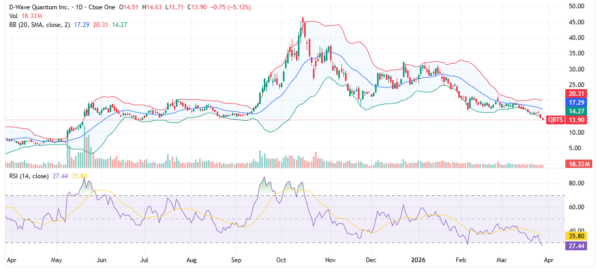
A Quick Look at the QBTS Chart
The price chart tells the story of a stock that ran hard and is now digesting those gains. QBTS surged from roughly $5 in the spring of 2025 to a peak near $12 in late 2025, fueled by the revenue acceleration and quantum sector enthusiasm. It has since pulled back to the $13–14 range, and the current setup warrants technical caution in the near term.
The 20-period Bollinger Bands show the stock trading near the lower band — a zone that can indicate oversold conditions, but which also reflects a stock in a sustained downtrend compression. The RSI (14) sits at approximately 27, firmly in oversold territory. While an RSI this low can precede a bounce, in trending downside environments it can also persist. Price is trading below both the 20-period SMA ($17.29) and the upper band ($20.31), confirming the near-term trend is negative.
For long-term investors, the chart is less relevant than the business trajectory. The current drawdown looks characteristic of a post-hype consolidation phase — the kind that typically precedes the next leg higher once commercial catalysts (the QCI integration, new enterprise contracts, the first dual-rail gate-model deployment expected in 2026) give the market something fresh to reprice. A cautious investor might watch for stabilization above the $12–13 support zone before initiating or adding to a position.
The Bottom Line
D-Wave Quantum is not a risk-free investment. It is a pre-profitability company trading at a steep premium to current revenue in a sector where timelines are uncertain, and competition is intensifying. Investors who need predictable returns should look elsewhere.
But for investors who can think in decades rather than quarters, the QBTS thesis is coherent and compelling. Quantum computing represents a generational shift in computational capability — one that will reshape drug discovery, logistics, finance, and national security infrastructure. D-Wave is the only company with both a working, commercial quantum business today and a credible roadmap to fault-tolerant systems tomorrow. The current pullback has brought the stock to levels that look more reasonable than its 2025 peak, and the technical picture suggests the market may be nearing exhaustion on the selling side.
The quantum revolution is not a question of if. It is a question of when — and whether you are positioned before the answer becomes obvious.
Leave a Reply