
With all of the chaos in the markets, it’s a good idea to protect your portfolio while still generating reliable income. One way to do that is to focus on high-yielding, income-producing stocks that can help smooth volatility over time.
Table of Contents
Real estate investment trusts (REITs) are among the best examples of this strategy for several reasons. For starters, most REITs can act as a hedge against inflation. When inflation rises, landlords can often raise rents. That’s not great for tenants, but it helps support revenue and dividends for shareholders.
Second, REITs are focused on both residential and commercial properties. We’re seeing a steady recovery in demand across key property types, including offices, apartment buildings, warehouses, hospitals, shopping centers, and hotels. At the same time, long-term trends like e-commerce and cloud computing are driving even stronger demand for logistics facilities, data centers, and digital infrastructure—areas that continue to see significant investment and growth.
Another advantage of REITs is their structure. By law, they must return a large portion of their taxable income to shareholders in the form of dividends. That makes them especially attractive for investors looking to generate consistent cash flow, even during uncertain market conditions.
Here are two REITs well-positioned to deliver these benefits today, making them an appropriate choice for income-oriented investors.
Crown Castle
With a yield of 5.5%, Crown Castle (NYSE: CCI) operates and leases more than 40,000 cell towers and approximately 90,000 route miles of fiber supporting small cells and fiber solutions across every major U.S. market. This infrastructure plays a critical role in keeping wireless networks running, especially as data usage continues to surge with 5G expansion.
The company also just declared a $ 1.0625-per-share quarterly dividend, payable on March 31 to shareholders of record as of March 13.
Most recently, the company posted fourth-quarter funds from operations (FFO) of $1.01, which beat expectations by five cents. Revenue of $1.07 billion, while down 4.5% year over year, still came in ahead of estimates. Management noted that full-year 2025 results exceeded expectations across key metrics.
Looking ahead, Crown Castle is making strategic changes aimed at improving efficiency and maximizing shareholder value. For long-term investors, its position in essential communications infrastructure could provide steady income along with gradual growth potential.
Digital Realty Trust
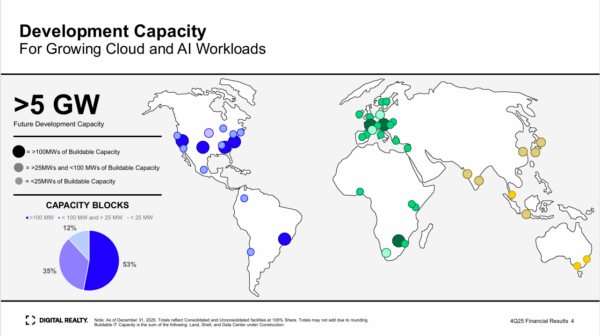
With a yield of 2.77%, Digital Realty Trust (NYSE: DLR) is one of the largest REITs in the U.S., operating more than 300 data centers worldwide. As demand for data storage and processing continues to surge, the company is well-positioned to benefit from one of the most important technology trends of the next decade.
The company recently declared a quarterly dividend of $1.22 per share, payable on March 31 to shareholders of record as of March 13.
Much of Digital Realty’s growth is being driven by the artificial intelligence boom. As companies invest heavily in AI, cloud computing, and big data, demand for data center capacity is expected to grow rapidly. In fact, analysts expect data center demand to rise significantly through 2030, with supply still struggling to keep up in key markets.
Financially, the company continues to show solid performance. In its fourth quarter, funds from operations came in at $1.81, just slightly below expectations, while revenue of $1.63 billion beat estimates and showed steady growth.
A Simple Way to Generate Income
In uncertain markets, smart investors keep things simple: focus on steady income and long-term growth. REITs like Crown Castle and Digital Realty Trust offer both, with reliable dividends and exposure to strong trends like wireless infrastructure and artificial intelligence.
No stock is risk-free, but companies with consistent cash flow can help reduce volatility and keep your portfolio on track. Over time, it’s this kind of disciplined, income-focused approach that can make a real difference.
Leave a Reply