
Broadcom (NASDAQ: AVGO) may be ranked among the top semiconductor companies, but like so many other tech players, fears of a brewing bubble in artificial intelligence have capped momentum this year. Since the start of January, AVGO stock is down roughly 8%. This poor print contrasts with the overall performance of almost 71% up over the past 52 weeks.
Table of Contents
However, with Broadcom scheduled to release its fiscal first-quarter earnings report on Wednesday after the market close, the tech giant could help steady the ship, both for AVGO stock and the broader AI ecosystem.
For the upcoming report, Wall Street analysts expect Broadcom to post earnings per share of $1.88 on revenue of $19.18 billion. What investors of AVGO stock have going for them is the company’s overall historical performance. Misses on either the top or bottom lines have been rare, with the last one occurring in December 2024 (a slight miss on sales).
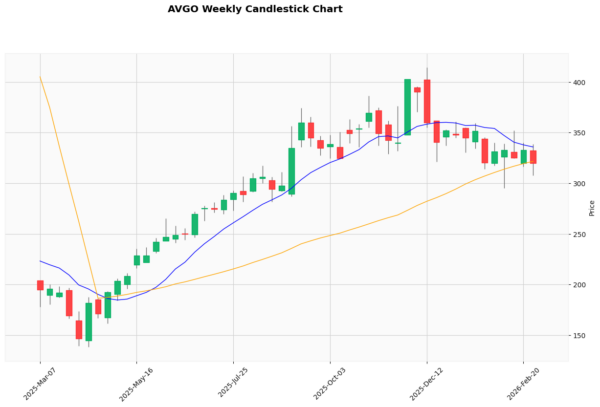
To be fair, the smart money appears to be in a protective mode ahead of the semiconductor firm’s Q1 disclosure, which isn’t all that surprising. Amid difficult economic circumstances and a volatile geopolitical environment, investors aren’t in a risk-taking mood at the moment. Still, this situation could be signaling a discounted play for contrarian call options.
Volatility Skew Provides Critical Intel on AVGO Stock
If you want to have a better idea of where a security may head next, you may consult volatility skew. While no one indicator provides a crystal ball, the volatility skew provides critical intel for retail traders. Definitionally, this screener identifies implied volatility (IV) — or a stock’s potential range of motion — across the strike price spectrum of a given options chain.
Colloquially, the skew offers a visual representation of the surface-area distortion of volatility space, allowing observers to see how the smart money (which represents the most active traders in the options market) is structuring its risk profile. Through this free indicator, we can see what outcomes the sophisticated participants fear the most — and whether they’re willing to pay extra premium to insure against said moves.
A useful analogy is a soccer team’s starting formation. In the case of AVGO stock, at least for the March 6 weekly options chain (and thus the first chain following Broadcom’s earnings report), the skew is structured in the equivalent of a 5-4-1 formation. In other words, with put and call IV rising at the far-left boundaries (toward lower strikes), the smart money is primarily interested in protecting against downside tail risk.
What’s more telling, the skew is relatively flat toward the right-hand boundaries (toward higher strikes). This setup suggests that the Wall Street pros are more worried about the possibility of losing money in Broadcom stock than they are about extracting profits through upside convexity.
That’s why I call this skew a 5-4-1 formation; there’s an extra (fifth) defender in lieu of a second forward. But this defensiveness means that call options could potentially be acquired at a discount, at least on a volatility basis. And that’s the possible opportunity we have for AVGO stock.
Establishing the Trading Parameters of Broadcom Stock
While we understand smart money positioning, how does this translate into actual price forecasts? For a quick reference, we have the Black-Scholes-derived expected move calculator. For the April 17 expiration date (which is about a month-and-a-half out from today), the calculator provides a dispersion between $261.43 and $357.63.
Frankly, the dispersion is just a basic expectation of what could materialize based largely on IV. The central issue behind the underlying Black-Scholes model is that the formula is static. In other words, no matter what context the target security is placed in, those who are relying exclusively on Black-Scholes will always use the same formula.
I find this process to be absurd because we know that probabilities shift based on context. For instance, when a stock is on a massive rally, the main concern for those pondering an investment decision is the risk of holding the bag. Conversely, if the same stock were suffering a catastrophic correction, the main fear for prospective participants is the threat of being lacerated by falling knives.
If you were relying on Black-Scholes to make a decision on this security, you would still apply the same formula. You wouldn’t take into account context because the math of Black-Scholes doesn’t allow for that context to be accounted for.
Now, you can start to understand why the Markov property is so important.
Using Conditional Probabilities to Chart Real Signals
Under Markov, the future state of a system depends entirely on the current state. Simply put, it’s a framework that takes into account prior context to establish conditional probabilities.
With Markov systems, we’re not trying to find out where Broadcom stock is likely to go next just from where it’s standing. That’s a ridiculous proposition. Instead, we’re trying to inductively determine where AVGO is likely to drift given its current market structure.
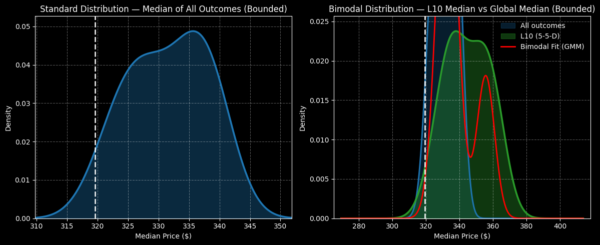
For example, over any given 10-week period, aggregate data going back to January 2019 reveals that AVGO stock is likely to range between $310 and $352 (assuming a spot price of $319.55, Friday’s close). However, right now, AVGO is structured in a 5-5-D sequence: five up weeks, five down weeks, downward slope.
Under this quantitative signal, AVGO’s forward 10-week returns are likely to range between $300 and $382, with probability density peaking between $330 and $350. Interestingly, the volatility skew for the April 17 expiration date shows a flat call IV at upper strike bounds, meaning that traders are still pensive about taking bold, bullish bets.
For the optimistic contrarian, this circumstance adds risk but also potential opportunity. For aggressive traders, I’d take a look at the 340/350 bull call spread expiring April 17. Should AVGO stock rise through the $350 strike at expiration, the maximum payout stands at 150%. Breakeven comes in at $344, improving the trade’s probabilistic credibility.
Leave a Reply