Analog Devices (NASDAQ: ADI) delivered record fourth-quarter revenue of $4.37 billion, up 42% year over year, and adjusted EPS of $4.06, beating Wall Street’s $4.32 billion and $3.89 estimates. Yet shares plunged 17.37% to $312.95 post-earnings because investors are looking beyond the record quarter.
Table of Contents
ADI is preparing to spend as much as $1.9 billion expanding capacity while a substantial portion of its customers have yet to return to normal purchasing levels. Management is investing ahead of a recovery that could unlock another growth leg, but it still has to prove that demand will arrive in time to justify the commitment.
Industrial Is Becoming the Other Half of the Story
Our Monday preview asked whether ADI could find another growth engine beyond data centers. The quarter delivered a compelling answer. Industrial generated $2.19 billion, representing 50% of revenue, while automotive contributed $1.04 billion, or 24%. They grew 55% and 21%, respectively. Communications advanced 81%, while consumer increased 7%.
The appeal is the breadth of ADI’s exposure. Industrial spans factory automation, aerospace and defense, and electronic test equipment, while automotive brings opportunities in advanced vehicle systems. ADI can participate in AI infrastructure spending without depending entirely on it. Industrial now accounts for half the business, giving the company a broader foundation for growth.
But the 55% industrial increase needs context. How much reflects a durable recovery across customers, and how much is concentrated in markets already performing exceptionally well?
The Customers ADI Is Waiting For
Management’s inventory commentary gives us the answer. Aerospace and defense, automated test equipment, and data centers are performing above their long-term consumption trends. Across much of the remaining customer base, shipments are still at or below those trends, and broad restocking has yet to materialize. This gap is the opportunity.
See, ADI has delivered record revenue without a full recovery across its customers. Which means that If broader industrial buyers begin ordering closer to their underlying consumption needs, the company could capture another leg of growth without requiring data-center demand to accelerate at the same pace.
But I wouldn’t assume that recovery is already here. Management expects industrial revenue to increase sequentially in Q1, but automotive is expected to decline low-single digits, and consumer could fall 10% to 15%.
A $1.9 Billion Bet on What Comes Next
ADI spent $733 million on capital expenditures in FY2026. For FY2027, management expects between $1.6 billion and $1.9 billion, more than double the previous year’s investment. The spending will support manufacturing capacity expansion.
That decision is understandable. If demand is building and manufacturing capacity is becoming a constraint, waiting until customers order more aggressively could leave ADI struggling to meet it. Expanding ahead of the cycle gives the company a chance to capture that demand.
But the commitment is substantial. ADI generated $5.45 billion in free cash flow during FY2026, equal to 36% of revenue, giving it considerable financial flexibility. Still, acquisitions, dividends and share repurchases also compete for that cash. The expanded manufacturing footprint must generate enough incremental revenue and cash flow to justify the investment.
The Earnings Beat Has a Quality Question
Adjusted gross margin reached 74.5%, compared with 69.8% a year earlier, while adjusted operating margin expanded to 52.3% from 43.5%. That is substantial operating leverage. However, Q4 GAAP operating margin was 42.7%, highlighting the sizeable gap between reported and adjusted profitability.
ADI excluded $415 million in acquisition-related expenses and $3.5 million in transaction costs from Q4 adjusted operating income. Full-year acquisition-related expenses reached approximately $1.6 billion. Much of this reflects acquired intangible amortization, but shareholders still need to see the acquisitions generate benefits that justify their costs.
Q1 guidance adds another complication, in that revenue is expected at approximately $4.4 billion, while adjusted EPS is forecast at $3.82, below the $3.89 consensus estimate. ADI is entering the new year with strong demand, but investors need evidence that growth and margins can support its enlarged capital base.
The Stock Now Has a Recovery of Its Own to Make
I like ADI’s business, but I want to see the $1.9 billion investment committed to capacity expansion translate into stronger orders and profitable growth before getting more aggressive.
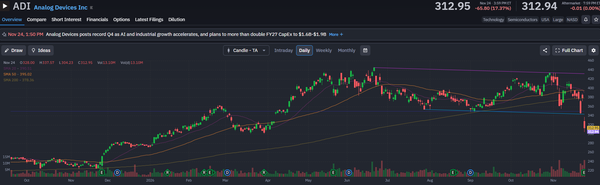
Technically, ADI closed at $312.95, down 17.37%, after breaking below the $350 support area. The selloff also pushed shares beneath their 20-day moving average at $390.51, 50-day at $395.02, and 200-day at $378.36. All three now sit overhead, creating a substantial resistance zone between $378 and $395.
The session low of $304.23 is the first level I’d watch on the downside. A break below it would leave the stock searching for another support area. On the upside, reclaiming $350 would be an early sign that buyers are returning, but I’d want to see the shares push through the 200-day average and eventually the 390-395 cluster before calling this a meaningful trend reversal.
For now, I’d keep ADI on the watchlist rather than rush into the selloff. The business has room to grow, but the chart needs to show that investors are ready to pay for that opportunity again.
Leave a Reply