The companies supplying the infrastructure behind AI can make money without owning the models that capture public attention. They sell computing capacity, networking, chips, and cloud services to whoever needs them. Alibaba (NYSE: BABA) wants to occupy that position while developing its own models and applications, giving it multiple ways to participate in the AI economy.
Table of Contents
Its second-quarter results show that one part of this strategy is beginning to produce substantial operating returns. Another is consuming billions, while the investment required to support both is putting increasing pressure on cash generation.
Cloud Is Delivering The Economics Alibaba Needs
Alibaba’s consolidated revenue increased 10% to RMB271.52 billion, but that figure conceals a significant shift in the company’s growth engine. AI Cloud and Compute Services revenue climbed 53% to RMB60.97 billion. External customer revenue advanced 64%, while recurring external revenue, excluding compute equipment solutions, grew 67%. AI-related product revenue reached RMB17.92 billion, extending its streak of triple-digit annual growth to 13 consecutive quarters.
The acceleration is occurring while Alibaba’s established commerce operations face a tougher environment. Alibaba E-commerce Group revenue grew just 2%. China customer-management revenue declined 5%, although management said it would have increased 1% excluding the revenue impact of its new business development program. International e-commerce revenue contracted 8%. Cloud is therefore doing much of the work behind Alibaba’s expansion, rather than simply benefiting from strength across the entire group.
Profitability makes that cloud performance even more convincing, as adjusted EBITA increased 121% to RMB8.84 billion, and the segment’s adjusted EBITA margin expanded from 10% to 14.5%. For the first six months, cloud adjusted EBITA had already grown 125%, with the margin reaching 13.2%. With the business generating stronger earnings as demand scales, Alibaba has a financial foundation for its infrastructure ambitions.
Its proprietary hardware program could strengthen that position. BABA plans to commercially release its Zhenwu V900 AI chip and launch a next-generation supernode in the first quarter of 2027. The supernode integrates proprietary interconnect, networking, and storage chips. Developing more of the infrastructure stack internally could give Alibaba greater control over supply and operating costs. But the hardware still needs to attract customers and deliver performance that justifies adoption against alternative suppliers.
Building The AI Application Business Is Costlier
The economics change sharply when we move from infrastructure to Alibaba’s own AI products. AI Labs and Applications revenue increased 51% to RMB4.44 billion, driven by demand for agentic AI products. Yet adjusted EBITA losses widened to RMB10.50 billion from RMB3.44 billion a year earlier. Across the first six months, the segment recorded a loss of RMB24.36 billion, compared with RMB6.66 billion in the prior-year period. Alibaba attributed the deterioration to greater investment in AI capabilities and higher inference costs associated with the Qwen app.
That spending deserves scrutiny because Alibaba is developing models, enterprise agents and consumer applications simultaneously. Its Qwen4-Max model, QwenWork platform, and Qwen app are intended to extend AI into business workflows and everyday tasks. However, product launches and expanding usage do not establish that Alibaba can command attractive prices or retain customers against rival models.
I would not make model superiority the deciding factor in the cloud investment case. A company can sell infrastructure to customers running competing models. Alibaba’s own applications, however, must eventually generate enough commercial value to justify their development and inference costs. Right now, the infrastructure operation is producing higher margins while the application segment is moving in the opposite direction.
The Infrastructure Bill Is Consuming The Cash
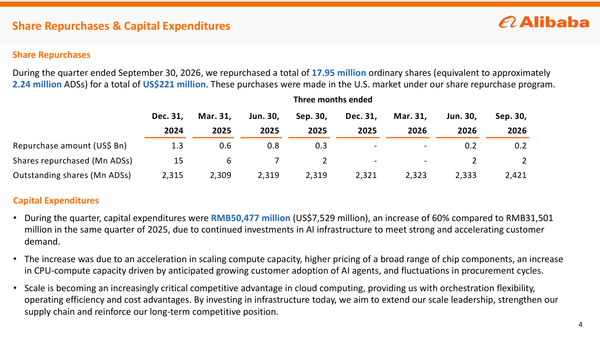
BABA spent RMB50.48 billion on capital expenditure during the quarter, up 60% year over year. Management attributed the increase to faster compute-capacity expansion, higher chip-component prices, additional CPU capacity in anticipation of AI-agent adoption and procurement-cycle fluctuations. It believes larger infrastructure providers gain advantages through orchestration flexibility, operating efficiency, and lower costs.
That rationale is plausible, but the cash-flow statement shows what shareholders are financing. Operating cash flow increased 55% to RMB15.69 billion, yet free cash flow was negative RMB34.47 billion, compared with negative RMB21.84 billion a year earlier. For the first six months, the outflow reached RMB79.14 billion, nearly double the RMB40.66 billion recorded in the comparable period.
Alibaba has the resources to continue. Cash and other liquid investments stood at RMB487.93 billion at September 30, against a net cash position of RMB220.72 billion. However, net cash had fallen from RMB260.83 billion at the end of March. The company is not facing an immediate funding crisis, but the direction of its cash position deserves attention as infrastructure spending accelerates.
There is another earnings detail investors should not overlook. September-quarter net income rose 213% to RMB64.42 billion, while non-GAAP net income increased 92% to RMB19.91 billion. Yet for the full six-month period, non-GAAP net income declined 7% to RMB40.62 billion, and non-GAAP diluted EPS fell 13% to RMB2.08. The quarter’s strong headline profit growth does not describe the entire earnings trajectory.
The Burden Of Proving Those Investments
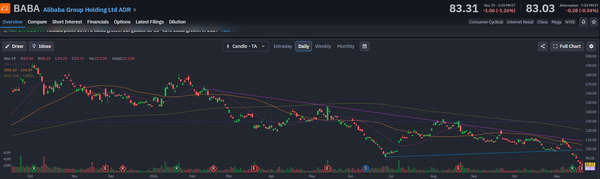
Post-earnings, Alibaba closed at $83.31, far below its 20-day moving average of $98.33, 50-day average of $104.89 and 200-day average of $121.21. The chart shows a persistent sequence of lower highs, followed by a break beneath the rising support line that had held through much of the second half of the year. The shares are now trading beneath all three moving averages.
A recovery would first need to reclaim the 95-100 region, followed by the 50-day average. Until then, the technical picture favors sellers, with the market showing little appetite to reward the company’s AI investment ambitions.
Alibaba’s cloud operation is developing into a stronger earnings business, but shareholders are also funding an expensive application strategy and an infrastructure expansion that is draining free cash flow. I would rather see the new capacity translate into sustained cash generation before treating the cloud growth rate as sufficient reason to buy the shares.
Leave a Reply