
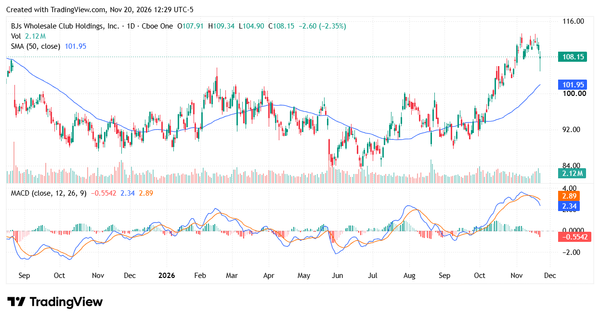
BJ’s Wholesale Club (NYSE: BJ) gave Wall Street a lot to like in its third-quarter earnings report. More shoppers visited its clubs, membership reached a record, and sales beat expectations. The retailer even raised its full-year profit forecast. Yet BJ stock fell about 7% in Friday’s premarket trading, leaving investors to wonder why a strong earnings report wasn’t enough to lift shares.
Table of Contents
BJ’s posted third-quarter revenue of $6.28 billion, up about 17% from a year earlier and ahead of the $5.97 billion analysts expected. Adjusted earnings came in at $1.73 per share, beating estimates by 47 cents. A year earlier, BJ’s earned $1.15 per share on an adjusted basis.
Sales at comparable clubs, which give investors a look at how established locations are performing, rose 13.5%. Excluding gasoline, they rose 4.1%, ahead of the 2.7% gain analysts expected. The figure that strips out fuel gives investors a clearer look at what’s happening inside the clubs, since changes in gasoline prices can swing reported sales.
CEO Bob Eddy credited strong traffic and highlighted the company’s 42nd birthday promotion.
Shopping through BJ’s digital channels also gained ground. Digitally enabled comparable sales rose 38% from a year earlier and were up 69% over two years. For a warehouse club, convenience can give members another reason to shop regularly. A member who can order online and collect groceries on the way home has one more way to use the membership between trips through the aisles.
BJ’s Membership Growth Could Offset Pressure on Merchandise Margins
Membership fee income rose 9.5% to $138.4 million. BJ’s attributed the increase to signing up members, keeping existing ones, and attracting more shoppers to higher-priced membership tiers. The gains came from both new and established clubs. That matters because opening more stores can bring in new members, while renewals give BJ’s a way to keep earning revenue from households it has already signed up.
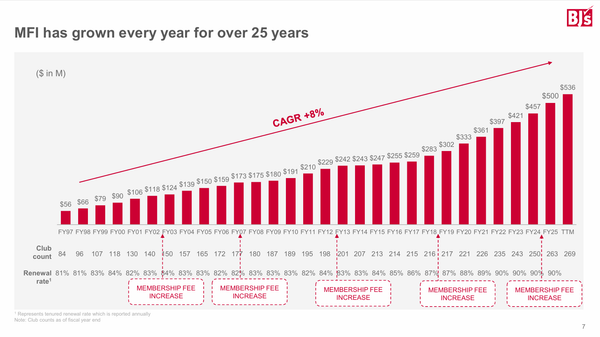
The merchandise business told a more complicated story. BJ’s merchandise gross margin fell 1.7 percentage points from a year earlier, primarily because of promotions tied to the birthday sale. In plain English, BJ’s kept less gross profit from each dollar of merchandise it sold. And even with the jump in revenue, total gross profit only edged up to $1.02 billion from $1.01 billion.
Discounts can give shoppers a reason to visit, try a product, or sign up for a membership. The payoff becomes clearer after the event. If those shoppers keep coming back and eventually renew, the promotion can pay off beyond the initial sale. If visits fade as prices return to normal, the quarter’s squeeze on margins will be harder to justify.
In addition, BJ’s recognized a roughly $240 million benefit, after legal fees, from a settlement over the fee merchants pay to accept credit cards. About $95 million in expenses associated with using the proceeds offset part of that benefit, leaving a net pretax boost of approximately $145 million. Gains from property sale-leaseback deals also helped, while labor, occupancy, and other operating costs rose as BJ’s expanded. The retailer opened two clubs and five gas stations during the quarter.
BJ Stock Faces a Holiday Test After BJ’s Raises Earnings Guidance
For fiscal 2026, which ends Jan. 30, 2027, BJ’s now expects adjusted earnings of $5.10 to $5.30 per share, up from its prior range of $4.60 to $4.80. The company also lifted the low end of its comparable-sales outlook. It now expects sales excluding gasoline to rise 2.5% to 3%, compared with its previous forecast of 2% to 3%.
The higher sales forecast is worth watching through the holiday quarter. BJ’s has a chance to show that the shoppers who came for the birthday deals will return for groceries and other everyday purchases. If traffic holds up while merchandise margins recover, the company will have a stronger case that it can turn busier clubs into lasting profit growth. At the next earnings report, those two numbers could tell investors more about where BJ’s is headed than another big headline earnings figure.
That will be particularly important for BJ stock. Investors need to see that the company’s strong sales growth can translate into sustainable earnings rather than relying on promotional activity and one-time financial benefits. At the next earnings report, merchandise margins, comparable sales, and membership renewals could tell investors more about where BJ’s is headed than another big headline earnings figure.
Leave a Reply