Retailers spend heavily to earn a customer’s next visit, but getting someone through the door is only half the sale. Target’s (NYSE: TGT) real strength has been its ability to turn routine shopping trips into broader purchases, with customers leaving for groceries and household essentials alongside clothing, beauty products, or something for the home.
Table of Contents
Its third-quarter earnings results show that traffic is recovering. However, the merchandise still needs to give shoppers stronger reasons to spend more.
Traffic Is Recovering, But The Basket Tells A Different Story
Net sales increased 7.1% to $27.07 billion, while comparable sales rose 5.6%, supported by a 5% increase in traffic. Store comparable sales advanced 4.6%, and digital comparable sales climbed 9.8%. Yet average transaction value increased just 0.6%. Target is attracting more shoppers, but spending per visit has barely moved.
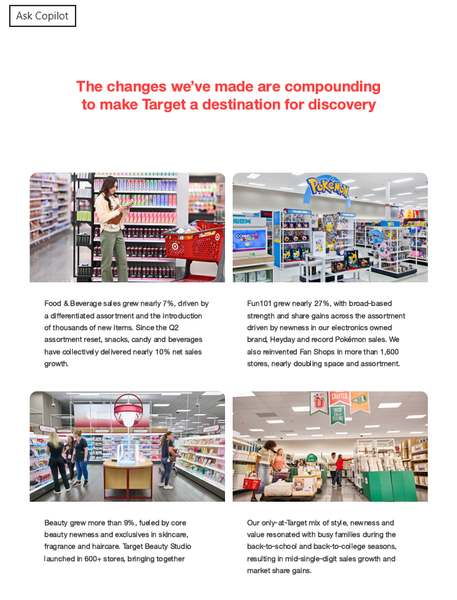
Food and beverage sales grew 6.6%, extending a growth streak that management said has lasted eight consecutive years. Target also recorded 40 million more transactions containing food year to date. Grocery purchases give customers a recurring reason to visit, creating opportunities to introduce them to other merchandise.
While food supports those regular visits, Fun 101 attracts shoppers through toys, gadgets, sports and pop culture. The category grew approximately 27%, with trading cards accounting for around 40% of its year-to-date growth. Even excluding trading cards, management said the category still delivered double-digit growth. Beauty also advanced 9.1%, supported by new brands and Target Beauty Studio, now present in more than 600 stores.
An analyst raised a useful challenge during the call, questioning whether trading-card purchases were generating isolated visits rather than broader shopping trips. CEO Michael Fiddelke pointed to Target’s focus on sustained traffic and cross-category shopping. I think this gets to the central issue. A customer buying a collectible is valuable, but the bigger opportunity comes when that visit also produces purchases in food, apparel, or home. The 5% traffic increase is encouraging. The 0.6% increase in transaction value leaves Target with something to prove.
Target Still Needs To Fix The Merchandise
That challenge becomes more apparent in apparel and home. Apparel and accessories sales declined 3.8%, while home furnishings and décor grew only 2.5%. These are categories that should encourage customers to add discretionary purchases to trips that began with everyday necessities.
Management acknowledged that women’s fashion had become too complicated, with inconsistent foundational products, fit, fabric, and quality weakening the value proposition. This is why Target plans to reduce women’s fashion style counts by approximately 20%, simplify the assortment, and lower prices on hundreds of products. Early improvement is expected in spring 2027. Management also identified women’s fashion and shoes as two underperforming areas.
This is a case of a merchandising operation that lost sight of what makes a larger assortment useful. More styles should give shoppers more opportunities to find something they want. When fit and quality become inconsistent, additional choices can make shopping harder rather than better. Cutting the assortment is a reasonable starting point, but Target still has to demonstrate that its remaining products offer the design, quality, and prices customers expect.
Home presents a slower challenge. Bedding delivered double-digit comparable sales growth during the first two weeks after its reset, with more than 75% of the assortment newly introduced and average prices approximately 15% lower. Management cautioned against treating two weeks of results as proof of a turnaround, describing the broader home recovery as a multiyear effort.
Tariff Refunds Flatter An Otherwise Improving Earnings Picture
Target reported adjusted EPS of $2.65, up from $1.78 a year earlier. The quarter included $301 million in tariff refunds, contributing approximately $0.50 per share. Removing that benefit leaves around $2.15 per share, implying underlying adjusted EPS growth of roughly 21%, consistent with CFO Jim Lee’s explanation during the call. That is still a meaningful improvement, although the headline figure overstates the growth produced by the underlying business.
Gross margin expanded 230 basis points to 30.5%, with approximately 110 basis points coming from tariff refunds. Excluding that contribution, gross margin still expanded around 120 basis points. Adjusted operating income excluding refunds increased 24%, while adjusted operating margin improved approximately 70 basis points. Supply-chain productivity and stronger non-merchandise sales helped offset higher freight and fuel costs.
Operating cash flow reached $5.73 billion during the first nine months, against $3.49 billion a year earlier. Capital expenditure was $3.76 billion, while inventory stood at $16.1 billion, up 8%. Target plans to spend $5 billion to $6 billion on capital expenditure in 2027, including store remodels, new locations, technology and supply-chain investments. Those investments need to improve the shopping experience enough to generate stronger sales and returns.
TGT’s Valuation Demands A Fuller Recovery
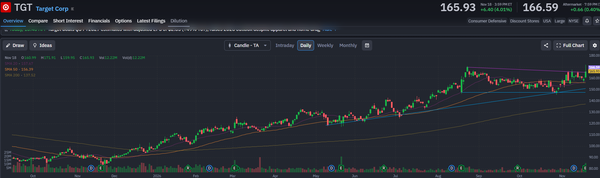
Target shares closed at $165.93 post-earnings, above their 20-day average of $157.67, 50-day average of $156.39 and 200-day average of $137.52. The 166-172 area represents immediate resistance, while $156-$157 is the first support zone. The moving averages point to improving sentiment, although the stock still needs to clear resistance.
At $165.93, Target trades at roughly 15 times the midpoint of its 10.65-11.40 adjusted EPS guidance. That guidance includes $2.14 per share in tariff refunds recognized year to date. Removing that contribution puts the implied multiple closer to 18.7 times underlying adjusted earnings at the midpoint.
Of course, Target deserves credit for improving traffic, margins, and underlying earnings. But the next stage depends on customers finding more to buy after they arrive. Until apparel and home regain traction and average transaction value accelerates, I would be cautious about chasing the rally.
Leave a Reply