Viking Holdings (NYSE: VIK) is finding its strongest growth engine in Ocean, but Q3 earnings exposed the strain elsewhere in the business. Revenue climbed 9.2% to $2.18 billion, while Adjusted EBITDA fell 4.3% to $673.5 million and adjusted EPS slipped from $1.20 to $1.11. Viking’s capacity passenger cruise days increased 10.2% year over year, but actual passenger cruise days advanced just 4.9%, leaving a widening gap between available berths and occupied capacity.
Table of Contents
The figures point to a growing divide inside Viking. Ocean is delivering stronger margins and booking growth, while River struggles with disrupted itineraries and an expanding cost base. Meanwhile, the company is committing billions to new ships that must eventually justify the investment.
River Fleet Is Struggling To Fill The Extra Berths
Viking added capacity passenger cruise days 10.2% year over year, but actual passenger cruise days advanced just 4.9%, leaving a widening gap between available berths and occupied capacity. Occupancy consequently fell to 91.3%, weakening the contribution Viking gets from its expanding River fleet.
Low water levels across Europe compounded that problem, forcing Viking to modify itineraries and accommodate guests through a difficult operating season. Although every scheduled cruise operated, disruptions and cancellations cost the company an estimated $100 million in third-quarter revenue and approximately $100 million in Adjusted Gross Margin impact.
By mid-November, roughly 70% of River capacity passenger cruise days had been affected, and 20% of guests booked on those itineraries had cancelled. Management had yet to quantify the full Q4 impact.
Vessel operating expenses then climbed 17.6% to $461.4 million, while expenses per capacity passenger cruise day increased from $174 to $186. Viking is spending more to operate a larger fleet while disruptions make those additional berths harder to monetize… leaving River with less room to absorb further operating pressure.
Ocean Is Pulling Viking’s Earnings Away From The River
Ocean has become the stronger contributor to Viking Holdings’ earnings, generating $1.75 billion in Adjusted Gross Margin during the first nine months of 2026, up 16.6% year over year. River produced $1.40 billion, growing just 1.9%. The difference is widening, and the operating figures show why.
Ocean filled 96% of capacity and generated net yield of $624, up 5.5%. River’s net yield reached $599, increasing just 1.6%, while occupancy lagged Ocean by nearly five percentage points. Ocean is filling more of its ships and extracting more revenue from every passenger cruise day.
Management expects Ocean to account for approximately 70% of new-build capacity through 2036, directing expansion toward the segment with stronger occupancy, higher yields, and faster margin growth. I agree with that strategy, but the returns on future ships remain to be proven. Each new vessel brings operating expenses, depreciation and financing demands, and Ocean must preserve its pricing power as capacity expands.
Viking Is Paying Guests To Come Back, And River Will Feel It
Viking’s voucher program complicates the picture behind River’s forward bookings, with $165 million in cancellation vouchers issued to guests who abandoned disrupted sailings and approximately $265 million in goodwill vouchers issued to those who completed their journeys. Around 60% of the cancellation vouchers had been rebooked by November 8.
Approximately half of the goodwill vouchers had also been redeemed, with 60% of those redemptions going toward 2027 sailings. Viking includes these redemptions in advance bookings at net value, so the headline figures do not represent entirely fresh, full-price demand.
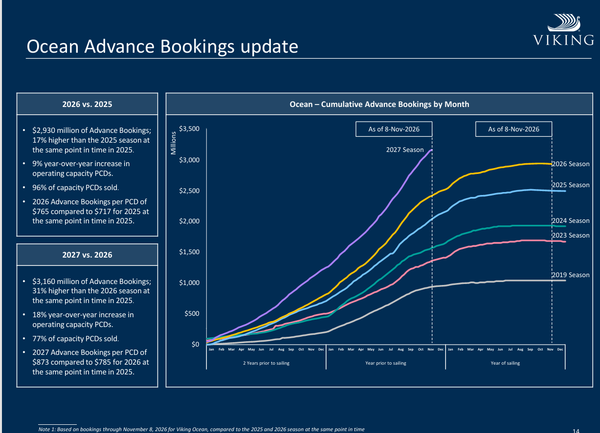
The program helps retain customers, but voucher use also reduces the value recognized when those guests return. River’s 2027 advance bookings stood at approximately $2.2 billion, broadly flat against the comparable period despite expected capacity growth of 13%. Ocean had secured approximately $3.2 billion, up 31%, against expected capacity growth of 18%. Ocean is growing booking value faster than its capacity, while River is preparing to bring more berths to market without comparable demand momentum.
River needs stronger demand from guests willing to pay for the experience. Repeat bookings protect customer relationships, but they do not erase the gap between capacity growth and booking performance.
The Fleet Expansion Is Eating Into Viking’s Cash Cushion
Viking generated $1.72 billion in operating cash flow during the first nine months, essentially matching the prior year, but investment in property, plant, equipment and intangible assets jumped to $1.32 billion from $869 million. After those investments, approximately $401 million remained, compared with roughly $854 million a year earlier.
The expansion program is consuming a much larger share of the cash generated by operations. Viking still has financial flexibility, with $4.1 billion in cash, $2.3 billion in net debt, and net leverage of 1.2 times at September 30. However, the $350 million spent on share repurchases during Q3 deserves scrutiny alongside the growing fleet commitments.
I would rather see Viking demonstrate stronger cash conversion from its expanding fleet before accelerating shareholder returns. The balance sheet can support the investment, but the ships must deliver earnings that justify the capital committed to them.
VIK Has Reclaimed Its Moving Averages, But $100 Stands In The Way
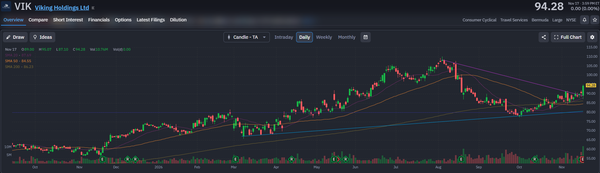
VIK stock closed at $94.28, above its 20-day moving average of $87.69, 50-day average of $84.55, and 200-day average of $86.23.. The recovery from October’s low near $78 has restored the short-term uptrend, although shares now face resistance between $95 and $100. A decisive move above $100 could open a path toward $105 to $108, near the descending trendline from August’s peak. Rejection at resistance could pull shares toward $90, with the moving-average cluster between $85 and $88 offering the next support zone.
I’m adding to my position here, but I want stronger cash generation before assigning the stock a richer multiple. As said, Ocean gives Viking a compelling growth engine, while River’s booking weakness and the rising cost of expansion leave plenty for management to prove.
Leave a Reply