
Super Micro Computer (NASDAQ: SMCI) is an ugly name; let’s just be upfront about that. Over the past 52 weeks, SMCI stock has lost nearly 31%. In the trailing month, the ticker is about 25% — and the volatility isn’t unjustified. Google Finance’s summary sheet notes ongoing regulatory overhangs and cash flow concerns. That’s putting it mildly.
Table of Contents
Of course, the ungarnished truth is that Super Micro is under U.S. Department of Justice (DOJ) scrutiny due to active federal investigations into the illegal export and smuggling of its artificial intelligence server systems to China in violation of U.S. export controls, per Google’s Research AI chatbot. China has also been in the news lately due to spying allegations regarding NVIDIA (NASDAQ: NVDA).
At the same time, this is also where the story takes an intriguing turn. NVIDIA recently released its third-quarter earnings report, featuring a top-and-bottom-line beat, along with a nice and unexpected pop in revenue guidance. Suddenly, the terrible-looking NVDA stock appears to be turning a corner, with the semiconductor giant up 3.3% during Tuesday’s after-hours session.
Subsequently, Super Micro Computer stock is also benefiting from riding NVIDIA’s coattails, gaining over 4% in after-hours trading following the latter’s Q3 report. The technical performance implies that the generative AI boom may still have long legs left. If so, it may be time to give SMCI a closer look.
This doesn’t mean that the IT company — which specializes in high-performance and high-efficiency servers — is decisively a strong investment idea. This regulatory matter remains a serious one, and it’s difficult to place long-term trust in SMCI stock given its wildly choppy performance over the past three years.
Nevertheless, from a quantitative perspective, Super Micro Computer stock has a history of transitioning from an extremely bearish state to a bullish one over the relative short term. As such, the contrarian position deserves a closer look.
Making the Quantitative Case for SMCI Stock
Primarily, the quantitative argument for Super Micro Computer stock revolves around the concept of inductive inference or reasoning. In terms of market context, this concept takes a specific signal and makes a generalized probabilistic principle. Because it’s an inductive discipline, there’s nothing that guarantees the desired outcome. Instead, it’s about playing the odds.
And what is the specific signal? To find out, we must convert the common share price format — which runs along a continuous scale with no theoretical upside limit — into a binary nomenclature of discrete categories. For example, in the past two months, SMCI stock has printed 10 weekly candlesticks. The specific signal, then, is that only three of the candlesticks were positive sessions (where Friday’s close was higher than Monday’s open).
Said differently, the ratio between negative weekly sessions versus positive ones stands at seven-to-three. What’s more, this ratio is quite rare for SMCI stock, having only materialized 27 times on a rolling basis over the past five years. Most enticingly, the typical response when this signal flashes in the charts is a gradual rise in the share price over the next 10 weeks, often to a higher degree than what would be expected under aggregate baseline conditions.
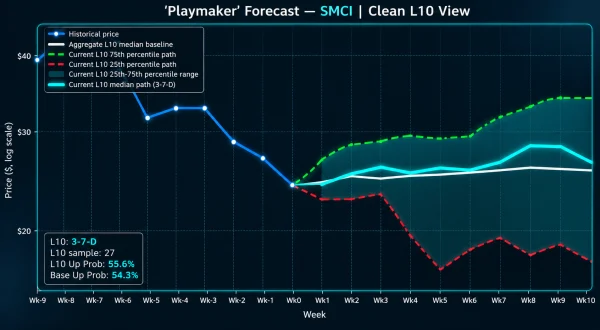
This boost in performance is most conspicuous around weeks 8 and 9. Further, the magnitude and frequency of the observed trend imply a 40.7% probability that SMCI stock will exceed the $30 price point on the January 2027 options chain.
If indeed the forecast pans out as expected over these next several weeks, the one idea that arguably stands out the most is the 27/30 bull call spread expiring Jan. 15. A bull spread is a form of a debit-side multi-leg options strategy where a sold call partially offsets the price of a bought call, resulting in a capped-risk, capped-reward transaction.
Using the EV Calculator for SMCI Stock
Now, every trader wants to know whether their proposed idea is a good deal or not. Ultimately, the myriad unknown variables of the equities market mean that the question can never be answered with absolute certainty. However, you can objectively improve the odds of discerning favorable terms over unfavorable with the expected value formula. That’s why the EV calculator is your most important trading tool.
Let’s look at the key stats for the 27/30 bull spread above:
- Net debit (upfront cost) of $100.
- Maximum payout (American-style odds) of 200%.
- Win probability (calculated from inductive analysis) of 40.7%.
Plug these numbers into the hyperlinked OddsJam.com’s EV calculator, and you get an expected value of $22.10 or a return on capital (ROC) of 22.1%. Why do I like this trade? Because it features an ideal balance between the cash you put up, the reward you potentially may get, and a decently sized probability.
Sure, there are cheaper spreads that you might be tempted to consider instead, such as the 28/30 bull spread (also expiring Jan. 15), which only costs $74. While the win probability would be the same (as you’re aiming for the same $30 strike), the EV would drop dramatically to $7.40. And that would translate to an ROC of only 4.35%.
That’s the beauty of the ROC calculator. At first blush, you don’t really see that the 28/30 spread is less efficient than the wider 27/30. Mathematically, though, the latter is simply the better deal when you consider the holistic, three-dimensional view of risk and reward.
It’s Still a Risky Trade
While I’m bringing to the table a combination of inferential reasoning and hard data, the quantitative nature of the argument for Super Micro Computer stock does not guarantee anything. Indeed, one of the flaws of using inferences in the market is that external shocks are part and parcel of the Wall Street machinery. And if that’s the case, an options trade would only exacerbate this volatility.
That said, I don’t believe there’s any other way of getting around the inferential flaws. One of the main reasons why a bull spread offers a fantastic reward — such as a 200% payout or higher — is the risk of the unknown. If the risk were absolutely known, there is no way in hell that you’re getting anywhere close to a 200% payout.
Simply put, if you want to play, you have to pay. My point is that if you have already made the decision to play, play smart.
Leave a Reply