
Joby Aviation (NYSE: JOBY) has spent more than a decade developing an electric aircraft designed to turn urban air travel into a commercial business. Its latest Q3 earnings show a company making progress toward that ambition, backed by $2.2 billion in cash and short-term investments. Yet the distance between developing an aircraft and operating a profitable air-taxi service remains expensive.
Table of Contents
Third-quarter revenue climbed 144% to $55.1 million, but the operating loss widened 53% to $278.1 million. Research and development expenses alone reached $208.6 million, up 40% year over year.
The revenue growth looks impressive; its source, however, reveals why investors still need to be cautious about the economics of this business.
Blade Generates Revenue While Joby’s Aircraft Remains In Development
Joby’s passenger revenue reached $53.2 million during the quarter, while other revenue contributed just $1.9 million. Almost all passenger revenue came from Blade, the air charter platform Joby acquired in August 2025.
Blade gives Joby an operating presence in passenger transportation while its electric aircraft moves through certification. But its growth doesn’t demonstrate demand for the company’s own eVTOL aircraft. Investors looking at the 144% revenue increase should recognize that most of this business still comes from conventional aviation.
The cost structure adds another complication. The company’s cost of revenue increased 288% to $39 million, substantially faster than revenue. Joby also spent $208.6 million on research and development and $85.6 million on selling, general, and administrative expenses.
In other words, Blade is expanding the revenue base, but the aircraft development program continues consuming capital without generating commercial aircraft revenue. The company needs both operations to contribute economically. At present, one is still being built while the other carries much of the reported passenger business.
FAA Certification Is Advancing, But the Expensive Work Isn’t Finished
The strongest part of Joby’s investment case remains its progress toward FAA type certification. The company has completed or substantially completed three of the five certification stages, reports more than 80% completion in Stage 4, and says it is progressing through Stage 5.
That progress gives Joby a meaningful position in the race to commercialize electric vertical takeoff and landing aircraft. The company also sees opportunities under the federal eVTOL Integration Pilot Program to begin initial flights in selected U.S. markets before full type certification.
Its government relationships offer another commercial avenue. In October, the company announced expanded U.S. Air Force contracts for autonomous flight technology, bringing the Air Force’s total commitment from $20 million to nearly $37 million.
However, certification progress and commercial approval are different milestones. Joby still needs the necessary production and operational authorizations. Regulatory changes or additional FAA requirements could delay its launch, extending the period in which development expenses arrive before meaningful aircraft revenue.
The $2.2 Billion Cushion Comes With a Dilution Trade-off
Joby ended September with $2.198 billion in cash, cash equivalents, and short-term investments. That provides substantial financial flexibility, but investors should examine how the company built that cushion.
During the first nine months of 2026, the company raised $576.3 million through a common stock offering, received $669.7 million from convertible notes, and generated another $128.2 million through its at-the-market offering. Its share count increased from approximately 915.1 million at the end of 2025 to 1.013 billion at September 30.
Operating cash outflow reached $486.2 million over nine months, averaging approximately $162 million per quarter. That spending rate makes the cash balance look substantial, but it also shows how much capital the company consumes before its aircraft business reaches commercial scale.
Joby’s planned $500 million acquisition of Resonant Sciences adds another consideration. The transaction is expected to be paid primarily in cash, with approximately $50 million in stock. The company also has up to $49 million in remaining potential contributions to its U.S. vertiport infrastructure arrangement.
The balance sheet provides room to execute, but its expanding commitments make capital allocation increasingly important. Investors are effectively funding several ambitions at once, from aircraft certification and manufacturing to infrastructure and defense technology.
Buyers Need To Defend the $4.43 Low
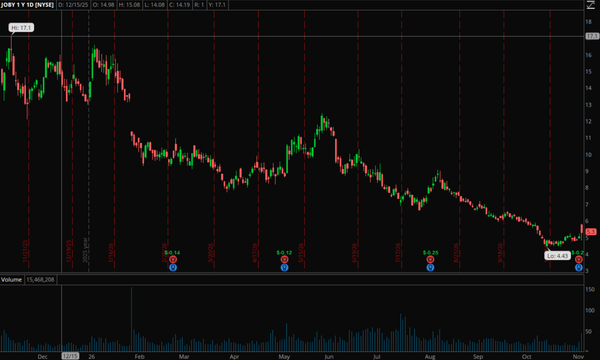
JOBY shares have fallen from a chart high of $17.10 to $4.43, establishing a prolonged sequence of lower highs and lower lows. The recent recovery toward $5.30 has yet to change that structure.
Speaking of volume, several of the largest trading spikes appeared during earlier declines, indicating heavy participation as shares sold off. More recently, trading activity has moderated as the stock approached its October low. That could signal selling pressure is easing, although declining volume alone doesn’t establish accumulation.
The $4.43 low is the immediate downside reference. Buyers need to defend that area and push through 5.50-6 to offer an early indication that demand is returning. The 7-8 region represents a more substantial overhead hurdle. A recovery accompanied by expanding volume would carry more conviction than a low-volume bounce.
More Execution Risk Than Commercial Proof
I’m leaning bearish on JOBY at its current stage. The $2.2 billion liquidity position and FAA certification progress make Joby a serious contender in the electric air-taxi market, but its financial performance hasn’t caught up with its ambitions. Blade supplies almost all passenger revenue, operating losses are widening, and the company continues raising capital to finance development and expansion.
That leaves shareholders exposed to certification delays, further dilution, and the possibility that commercial operations take longer or cost more to scale than management expects. The technology may eventually support a valuable aviation business, but the stock is still asking investors to pay for that outcome before the industry has demonstrated the economics. For now, the execution risk outweighs the commercial proof.
Leave a Reply