
The U.S. may be running short on rare earth. After launching hundreds of missiles and guided weapons against Iran, there are reports from Reuters and the South China Morning Post that the U.S. may only have weeks of certain rare earth minerals available to build more of those weapons.
Table of Contents
Rare earths are used in many parts of modern military systems, such as the Tomahawk missile, which relies on samarium-cobalt magnets in its actuators and guidance tail fins to withstand high heat.
For years, the U.S. has been overly dependent on China, which controls about 80% of the world’s rare earth supply. However, as we’ve learned the hard way, that has to change. After all, without rare earths, the world can’t produce the millions of electric vehicles government leaders want on the roads.
We can’t produce smartphones, computers, flat panel televisions, wind turbines, electric vehicle batteries, computer chips, defense equipment, semiconductors, digital cameras, or catalytic converters. Even the U.S. Department of Defense could run low on rare earths for rare earths and other warfighting products.
The good news is that the world is on its way to breaking its dependence on China. For investors, that also means there can be opportunities in some key stocks in this sector.
USA Rare Earth
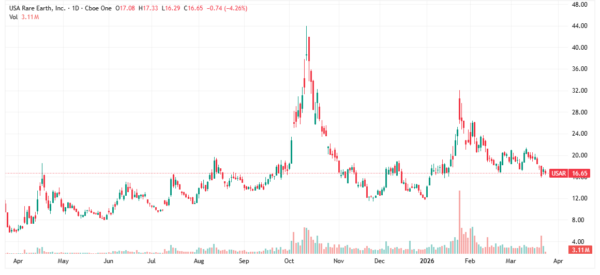
Shares of USA Rare Earth (NASDAQ: USAR) have been explosive.
Fueling upside, the company just got a buy rating from analysts at Benchmark, with a price target of $15. Benchmark noted that USAR’s plans to construct a 1,600-metric-ton-per-annum oxide processing facility in Lacq, scheduled for commissioning in late 2026, will help strengthen Europe’s rare-earth supply chain.
“The French government will provide substantial subsidies for the project, covering 45% of eligible equipment costs and €130 million for real estate expenses,” added Investing.com.
Helping, USAR also has more than $3 billion in potential funding, including a potential $1.6 billion from the U.S. Commerce Department to build a domestic rare earth and critical mineral supply chain, CEO Barbara Humpton said in an interview with Bloomberg.
“The defense sector knows that they need to choose different sources of supplies from China,” the CEO told Bloomberg. “The conversations we are having today say that they are willing to make commitments years from now in order to ensure that supply.”
MP Materials
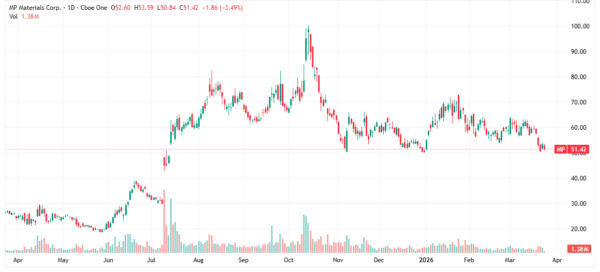
We also have to consider that MP Materials (NYSE: MP) has become a powerhouse stock after announcing a deal with the U.S. Department of Defense in July 2025, which would help accelerate the build-out of an end-to-end U.S. rare earth magnet supply chain and reduce foreign dependency.
As noted in a company press release, “Rare earth magnets are one of the most strategically important components in advanced technology systems spanning defense and commercial applications. Yet today, the U.S. relies almost entirely on foreign sources. This strategic partnership builds on MP Materials’ operational foundation to catalyze domestic production, strengthen industrial resilience, and secure critical supply chains for high-growth industries and future dual-use applications.”
VanEck Rare Earth and Strategic Metals ETF
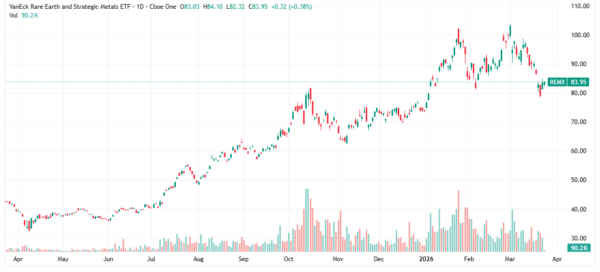
With an expense ratio of 0.58%, the VanEck Rare Earth and Strategic Metals ETF (NYSEARCA: REMX) attempts to replicate the performance of the MVIS Global Rare Earth/Strategic Metals Index, which is intended to track the overall performance of companies involved in producing, refining, and recycling of rare earth and strategic metals and minerals. Some of its 30 holdings include MP Materials, Lynas Rare Earths (OTCMKTS: LYSCF), Albemarle (NYSE: ALB), Pilbara Minerals (OTCMKTS: PILBF), and Ganfeng Lithium (OTCMKTS: GNENF).
Why Rare Earth Stocks Are Gaining Strategic Importance
The growing strain on U.S. rare earth supplies is more than a short-term geopolitical issue—it’s a long-term national security and industrial priority. As defense demand accelerates and clean energy transitions continue, the need for a reliable, domestic supply chain is becoming critical.
That shift is already creating momentum for companies positioned to fill the gap. USA Rare Earth offers early-stage upside tied to funding and infrastructure buildout, while MP Materials provides a more established, government-backed pathway to domestic production. Meanwhile, the VanEck Rare Earth ETF gives investors diversified exposure to the global supply chain.
For investors, the takeaway is clear: rare earth elements are no longer a niche commodity—they are a strategic asset. As the U.S. works to reduce its dependence on China, these stocks could remain in focus for years to come.
Leave a Reply