Shares of Serve Robotics (Nasdaq: SERV) surged more than 10% in pre-market trading on Thursday after the autonomous delivery robot company reported fourth-quarter and full-year 2025 results that blew past Wall Street expectations. For risk-tolerant investors looking for a direct, liquid way to bet on the future of autonomous robotics, SERV may be worth a serious look — even if it isn’t for the faint of heart.
Table of Contents
Earnings Beat Sets the Stage
Serve Robotics delivered Q4 2025 revenue of $0.9 million, a roughly 400% jump from the same period a year ago and ahead of Wall Street’s estimate of just under $0.8 million. Full-year 2025 revenue came in at $2.7 million, topping its own guidance of $2.5 million. The company also beat on the bottom line, reporting a net loss of $0.46 per share against analyst expectations of a $0.54 loss.
More importantly for investors, management raised 2026 revenue guidance dramatically — to approximately $26 million, nearly 10 times 2025 levels. That guidance blew past the Wall Street consensus of roughly $16.2 million, a gap that immediately caught the attention of both bulls and bears. The raised outlook is driven by continued deployment of the company’s Gen3 delivery robots and the addition of Diligent Robotics, a hospital robot company that Serve Robotics acquired to expand into the healthcare vertical.
The company ended 2025 with $260 million in cash and marketable securities, giving it ample runway to fund operations and capital expenditures, which management guided to approximately $25 million for 2026. That balance sheet — a product of prior equity raises — is arguably the company’s most important safety net as it attempts to scale its fleet and reach profitability.
Serve Robotics: A Real Business With Real Traction
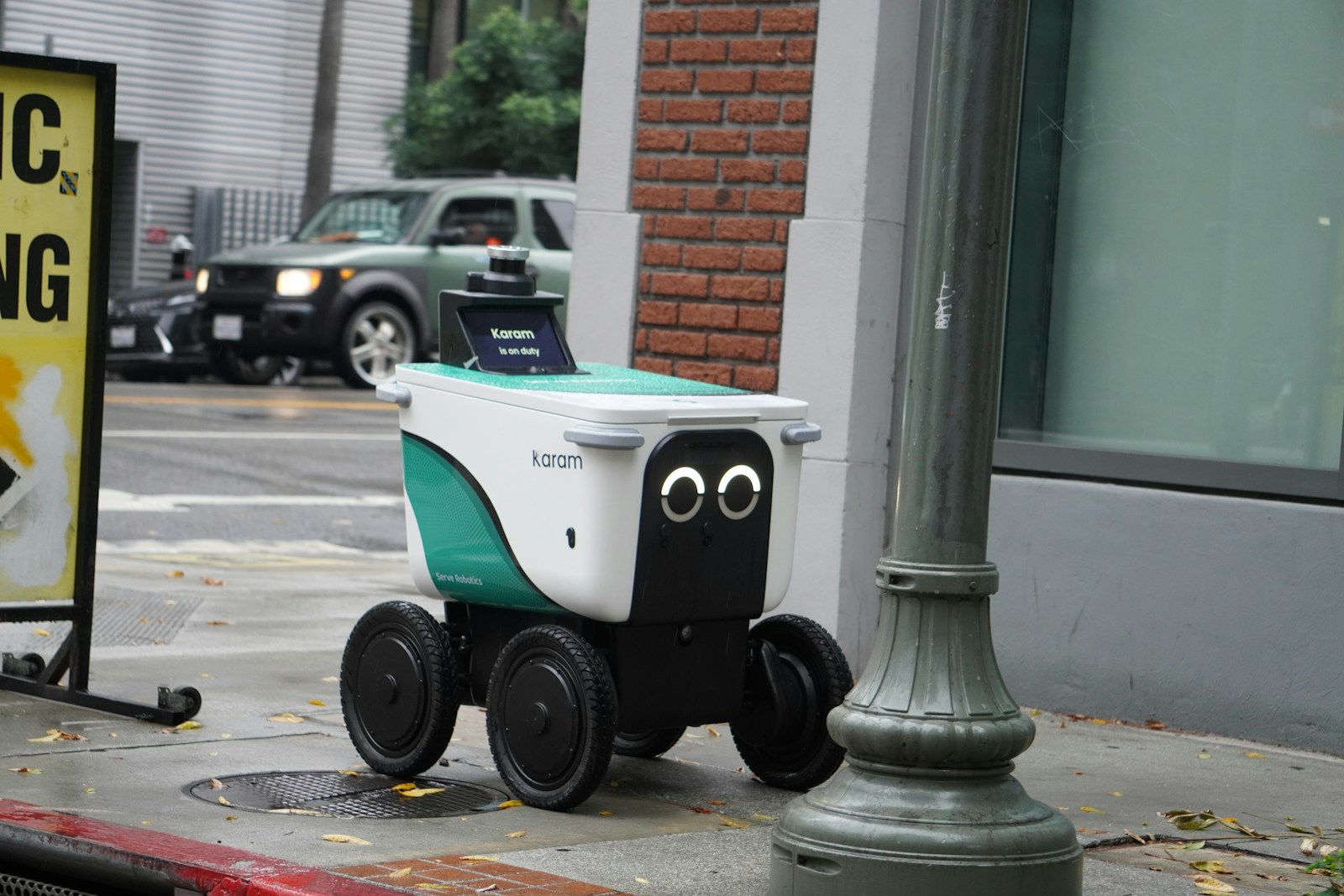
Skeptics of early-stage robotics companies have good reason to be cautious. The space is littered with impressive demos that never translated into commercial results. Serve Robotics is different in one important respect: it actually has paying customers and a fleet in the field. The company deployed 2,000 Gen3 robots across 20 U.S. cities by year-end 2025, up from roughly 100 robots just twelve months earlier — a 20x expansion in fleet size. Its robots are currently operating in Los Angeles, Miami, Dallas, Atlanta, Chicago, and other markets.
Serve Robotics’ robots are integrated directly into Uber Eats and DoorDash, the two largest food delivery platforms in the United States — covering an estimated 80% of U.S. food delivery demand. Rather than competing with those platforms, Serve powers them, benefiting from demand that is already proven and does not require creating new consumer behavior. The company currently serves 4,500-plus merchant partners and has completed over 1.8 million sidewalk and hospital deliveries to date, maintaining an industry-leading 99.8% delivery completion rate.
The unit economics pitch is compelling on paper. Today’s last-mile delivery costs $8 to $10 per delivery when using a human courier. Management projects their robots can execute the same delivery for under $1 at scale, eliminating driver wages, insurance overhead, and scheduling constraints with robots that can operate up to 14 hours a day. The Gen3 robot represents a 65% unit cost reduction versus its predecessor — manufactured at scale by Magna International, a tier-1 automotive supplier.
High Short Interest: A Potential Rocket Fuel for a Squeeze
One of the more intriguing dynamics surrounding SERV stock right now is its elevated short interest, which sits at approximately 29% of the float. That’s a significant short position — and it creates a potential short-squeeze setup that technically oriented investors will want to monitor closely.
When a stock has high short interest and then delivers a catalyst — like a blockbuster earnings beat combined with a dramatic guidance raise — short sellers who bet against the stock are forced to buy shares to cover their positions and limit losses. That buying pressure stacks on top of regular investor demand, and can produce sharp, rapid price appreciation. SERV’s pre-market surge of over 10% on earnings day is consistent with early-stage short covering, but with nearly a third of the float still short, the potential for additional covering pressure remains if the stock continues to gain momentum.
It is worth noting that high short interest is a double-edged sword. Short sellers as a group tend to be sophisticated investors, and their bearish bets on SERV reflect real concerns — primarily around the company’s ongoing losses, dilution risk, and the question of when (or whether) the business will reach profitability. SERV reported an adjusted EBITDA loss of $28 million for 2025, and guided for non-GAAP operating expenses of $160 to $170 million in 2026 against only $26 million in expected revenue. The bulls are betting on an inflection that is still some distance away. But for a short-term catalyst play, the squeeze setup is real.
Analysts Are Bullish, But Institutions Are Cautious
Wall Street analysts who cover SERV are broadly bullish. The stock carries a Buy consensus rating, with a median 12-month price target of $17 to $18.80 — implying upside of 60% to 75% from current levels. Northland Capital has an Outperform rating with a $26 price target, suggesting the potential for more than a double from current prices. Oppenheimer also initiated coverage with an Outperform rating and a $20 target. Freedom Capital and Ladenburg Thalmann both carry strong-buy ratings.
Wall Street analysts who cover SERV are broadly bullish. The stock carries a Buy consensus rating, with a median 12-month price target of $17 to $18.80 — implying upside of 60% to 75% from current levels. Northland Capital has an Outperform rating with a $26 price target, suggesting the potential for more than a double from current prices. Oppenheimer also initiated coverage with an Outperform rating and a $20 target. Freedom Capital and Ladenburg Thalmann both carry strong-buy ratings.
Technical Picture: Above the 50-Day, Momentum Building
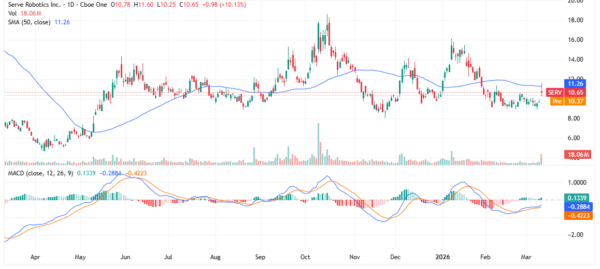
From a technical standpoint, SERV’s chart heading into earnings showed a stock that had been trading below its 50-day simple moving average (currently at $11.26) for much of the prior three months, forming a base in the $9 to $11 range after retreating from highs around $18 to $19 in the fall of 2025. The pre-market surge on earnings brings the stock back up toward and potentially through that 50-day resistance level — a technically significant development that often attracts momentum buyers.
The MACD indicator on the daily chart is showing an emerging bullish crossover, with the MACD line crossing above the signal line. Volume on the earnings day was running at approximately 18 million shares in early trading — well above average — confirming strong participation in the move. For a sustained rally, the stock will need to close and hold above the $11.26 fifty-day moving average, and then push through the $12 to $13 area where prior resistance is visible on the chart. A failure to hold those levels could signal that the earnings pop was primarily short covering rather than the beginning of a new uptrend.
The Bottom Line: High Risk, High Reward
Serve Robotics occupies a genuinely compelling position in the autonomous robotics landscape. It has built the largest commercial sidewalk robot fleet in the United States, locked in partnerships with both dominant food delivery platforms, and is now expanding into healthcare robotics through the Diligent acquisition. The revenue trajectory — from $1.8 million in 2024 to $2.7 million in 2025 to a guided $26 million in 2026 — is the kind of growth curve that historically attracts significant investor attention.
But investors need to enter with eyes open. This remains a pre-profitability company burning through cash to scale. The $160 to $170 million non-GAAP operating expense guidance for 2026 dwarfs the $26 million revenue target — a gap that will need to close significantly before profitability becomes realistic. Dilution risk is real, and the company may need to raise additional capital down the road. The stock’s high beta and elevated short interest mean violent moves in either direction are likely.
For risk-tolerant investors who believe autonomous robotics is the future of last-mile logistics — and who are comfortable riding significant volatility — SERV offers one of the clearest, most liquid ways to play that thesis in public markets today. Position sizing discipline is essential. This is a story stock in the early innings of what could be a transformative business, and the earnings results suggest the company is executing on its roadmap. Whether that execution ultimately justifies the current valuation is a debate that Wall Street will be having for some time.
Leave a Reply