
Ross Stores (NASDAQ: ROST) and Target (NYSE: TGT) both reported fourth-quarter and full-year 2025 earnings on March 3. Heading into earnings, the contrast between the two retailers could not be more striking.
Table of Contents
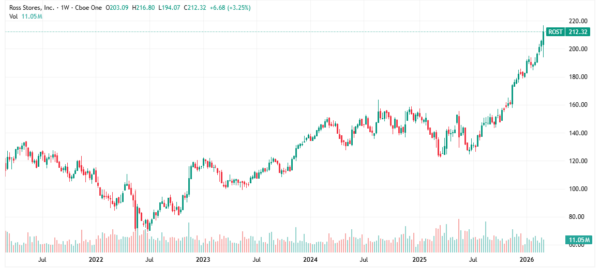
ROST stock has been one of the market’s most consistent performers, rewarding investors with a steady climb from pandemic-era lows to fresh all-time highs above $212. TGT stock, meanwhile, has spent the better part of four years in a drawn-out decline from its 2021 peak near $270, and sits today around $122.
With both companies having delivered solid reports, investors face a compelling question: do you stay with a proven winner trading at a premium valuation, or do you bet on a turnaround story that appears to be gaining real momentum?
Target: Beating Expectations and Betting on Growth
Target’s Q4 2025 results were mixed, but better than feared. Fourth quarter net sales came in at $30.45 billion, essentially in line with estimates for $30.47 billion. On the bottom line, adjusted EPS of $2.44 beat expectations of $2.16 by more than 12% and came in ahead of the prior year’s $2.41 on the same basis.
The report also showed gross margin improvement to 26.6% from 26.2% a year ago, driven by lower shrink and reduced supply chain costs. However, full-year comparable sales declined 2.6%, and annual adjusted EPS came in at $7.57, down from $8.86 the prior year, as the company absorbed meaningful headwinds from markdowns and purchase order cancellation costs.
The more bullish signal came from management guidance and commentary. CEO Michael Fiddelke noted that Target delivered a healthy, positive sales increase in February. Fiddelke predicted this will be a meaningful early read on the new fiscal year.
For full-year 2026, the company guided to roughly 2% net sales growth and an operating income margin rate approximately 20 basis points above the 4.6% adjusted rate in 2025. EPS guidance of $7.50 to $8.50 suggests management expects to return to earnings growth, backed by accelerating digital initiatives including a 30%-plus surge in same-day delivery and membership revenue that more than doubled year over year.
With TGT stock trading near multi-year lows and the forward P/E sitting well below the broader consumer discretionary sector, the valuation case is increasingly compelling — even if the stock remains elevated relative to its own five-year trough.
Ross Stores: A Blowout Quarter That Raises Valuation Questions
Ross Stores delivered a quarter that blew past every metric. Total Q4 sales jumped 12% to $6.6 billion, and comparable store sales surged 9%. That was nearly triple the 3% gain posted in the year-ago period. Earnings per share of $2.00 came in well above the company’s own guidance range of $1.77 to $1.85. Operating margin hit 12.3%, surpassing the planned range of 11.5% to 11.8%.
For the full fiscal year 2025, sales reached a record $22.8 billion, and the company generated over $3 billion in operating cash flow.
Looking ahead, Ross guided first-quarter comparable-store sales growth of 7% to 8%, with EPS projected at $1.60 to $1.67, up from $1.47 a year ago. Full-year fiscal 2026 EPS is guided at $7.02 to $7.36. The Board also authorized a new $2.55 billion two-year repurchase program — a 21% increase over the prior program. Plus, the company raised the quarterly dividend 10% to $0.445 per share.
All of that is genuinely impressive execution. The concern for new buyers is that at over 30x trailing earnings and trading near all-time highs above $212, a great deal of good news is already priced into ROST stock. Analysts remain broadly bullish, but the margin of safety for a fresh entry is thin.
Technical Analysis: Momentum vs. Mean Reversion
The weekly charts for ROST and TGT tell starkly different stories. ROST stock bottomed near $75 in late 2022 and has since nearly tripled, accelerating sharply higher in early 2026 to print fresh all-time highs on heavy volume. The trend is unambiguously bullish, and there is no visible technical resistance overhead — a hallmark of a true breakout. Momentum traders and growth-oriented funds have little reason to sell.
TGT stock presents the inverse setup. After cratering from its 2021 peak of roughly $270 to a low near $90 in early 2025, the stock has staged a recovery to the $120 range. Critically, TGT is now testing a long-standing area of horizontal support-turned-resistance near $125 to $130. A decisive close above that zone would represent a meaningful technical breakout and could attract trend-following capital. 4.
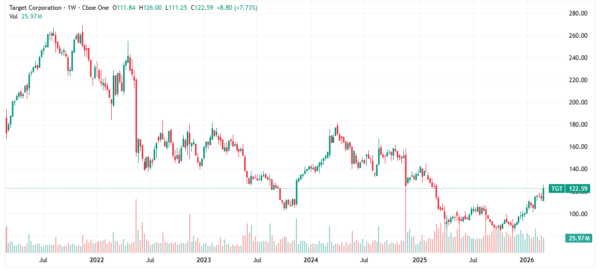
Until that happens, the stock remains in a multi-year downtrend on a weekly basis, and the pattern fits the profile of a base-building turnaround rather than a confirmed momentum trade. For investors with patience, TGT’s current setup may offer a better risk-reward than ROST’s extended chart.
Risks to the Retail Thesis
Neither stock is without risk. Both retailers flagged tariff headwinds as a material concern, given the significant share of merchandise sourced internationally. A renewed escalation in trade policy could compress margins across the sector.
Consumer spending data remains mixed, with lower-income shoppers under particular pressure from persistent inflation. This is a headwind that could disproportionately slow discretionary purchases even at off-price chains.
For Target specifically, execution risk remains real; the company has missed expectations in multiple recent quarters, and its guidance assumes a turnaround that has yet to fully materialize. For Ross, the risk is simpler but equally important: at 30-plus times earnings, any growth deceleration could trigger a sharp re-rating lower.
Conclusion: Two Valid Strategies, One Asymmetric Opportunity
ROST stock remains a high-quality compounder with exceptional execution, strong shareholder returns, and bullish analyst sentiment — but it is priced for perfection. TGT stock is not priced for perfection; it is priced for continued mediocrity, and the Q4 results suggest that mediocrity may finally be giving way to genuine recovery.
For momentum investors, Ross is the cleaner trade. For contrarian or value-oriented investors willing to accept some execution risk, Target’s combination of a depressed valuation, improving fundamentals, and aggressive growth investment may represent the more asymmetric opportunity heading into 2026.
Leave a Reply