
Nuclear power is having its moment — and small modular reactors (SMRs) are at the center of it. As artificial intelligence data centers, cryptocurrency mining operations, and advanced manufacturing facilities push electricity demand to levels the grid was never designed to handle, the energy industry is confronting an uncomfortable truth: intermittent renewables alone cannot deliver the always-on, carbon-free power that the modern economy demands. That gap is where Oklo (NYSE: OKLO) is planting its flag.
Table of Contents
Unlike the massive, multi-billion-dollar reactors that defined the first nuclear era, small modular reactors are compact, factory-built, and designed for faster, cheaper deployment. They can be sited closer to the communities and industries that need power, and scaled incrementally as demand grows. Oklo’s Aurora powerhouse, the company’s flagship SMR concept, is designed to run on advanced nuclear fuel and even recycle used nuclear material — a circular energy model that no fossil fuel can replicate.
The demand tailwinds are real and accelerating. Tech giants, including Meta Platforms (NASDAQ: META), have already signed agreements with Oklo for up to 1.2 gigawatts of future nuclear capacity. Institutional investors have taken notice — they now own more than 85% of OKLO’s outstanding shares. Wall Street analysts carry a consensus “Buy” rating with an average price target that implies substantial upside from today’s levels. The nuclear renaissance is no longer a thought experiment; it is beginning to attract serious capital and serious customers. Oklo sits at the intersection of that transformation — pre-revenue, yes, but arguably better positioned than any pure-play SMR company in the public markets.
Oklo’s Vertically Integrated Nuclear Business Model Could Drive Long-Term Growth
Most energy companies choose a lane — generation, fuel supply, or waste management. Oklo is trying to own the entire stack. The company operates across three business units: power, fuel, and isotopes. Its power business is developing the Aurora powerhouse, a compact fast reactor designed to generate 15 to 50 megawatts of electricity per unit. The fuel business is pursuing pathways to produce and recycle High-Assay Low-Enriched Uranium (HALEU), the advanced fuel that next-generation reactors require — a supply chain that is currently a chokepoint for the entire advanced nuclear industry. The isotopes business, centered on a project in Groves, Texas, targets medical and industrial isotope production, diversifying the company’s revenue potential beyond electricity generation.
This integration is strategically significant. By controlling fuel inputs and managing used nuclear material, Oklo is positioning itself to avoid the supply-chain vulnerabilities that have plagued nuclear projects for decades. If it works, the model creates compounding competitive advantages: proprietary fuel recycling reduces operating costs, isotope revenues de-risk the business during the long runway to commercial power sales, and a unified technology platform lowers the per-unit cost of future reactor deployments. CEO Jake DeWitte has described 2025 as a “step-change” year, marking the transition from product development to active project deployment at the Idaho National Laboratory and at a commercial site in Ohio.
Earnings Report Highlights Pre-Revenue Risks and Cash Burn Concerns
Oklo reported Q4 2025 results on March 17, 2026, and the headline numbers were not pretty. The company posted a loss of $0.27 per share for the quarter, missing the consensus estimate of -$0.17 by roughly 59%. Revenue came in at zero — exactly as expected for a pre-commercial company, but still a sobering data point. For the full year, the loss from operations totaled $139.3 million, with payroll and business expenses cited as the primary drivers.
The saving grace is the balance sheet. Oklo ended 2025 with approximately $1.4 billion in cash and marketable securities, then raised an additional $1.18 billion in January 2026 through the completion of its at-the-market equity program — giving the company roughly $2.5 billion in total liquidity.
Management guided for $80 million to $100 million in cash used in operating activities for 2026, alongside $350 million to $450 million in investing activities tied to project execution across Idaho, Ohio, and Tennessee. Despite the earnings miss, shares initially rallied more than 8% in aftermarket trading as investors focused on the liquidity cushion and strategic progress rather than the widening loss.
Key Risks for Oklo Stock: Regulatory Delays, Funding Needs, and Execution Challenges
The bull case for Oklo rests on a series of milestones that have yet to be achieved — and each one carries meaningful execution risk. The most immediate challenge is regulatory. Oklo’s combined license application with the Nuclear Regulatory Commission has faced prior setbacks, and while progress has resumed, any further delays in securing construction or operating licenses would push the commercial revenue timeline beyond the currently projected late 2027 or early 2028 window. First-of-a-kind projects routinely encounter cost overruns, and even moderate capital overages could materially erode the internal rate of return on Oklo’s initial powerhouses.
The macroeconomic environment adds another layer of uncertainty. If a broader economic slowdown causes technology companies to pull back on data center capital expenditures, the near-term demand for dedicated nuclear power agreements could soften. Corporate clean-energy commitments are often the first casualty of a tightening budget cycle. Meanwhile, short interest, while declining, still represents approximately 15% of the float — a meaningful contingent of investors who remain skeptical that Oklo can execute on its ambitious timeline. Insider selling has also been notable, with executives and directors collectively disposing of millions of shares in recent months, a pattern that cautious investors are right to monitor even if the transactions occur under pre-planned trading programs.
Bearish Trend Shows Signs of Stabilization
The chart tells a story of a stock searching for a floor after a dramatic cycle. OKLO surged from roughly $25 in early spring 2025 to a peak near $175 in late October before surrendering most of those gains in a sustained downtrend that has carried shares into the mid-$50s. The stock is now trading below both its 50-day and 200-day moving averages, which continue to slope downward — a classically bearish configuration.
However, there are early signs of stabilization worth watching. The RSI (14) has moved into the mid-30s, approaching but not yet breaching the oversold threshold that has historically preceded bounces in high-beta growth names. The MACD remains negative with the signal line below zero, confirming that momentum has not yet turned, but the histogram bars are compressing — a potential early warning that selling pressure is fading.
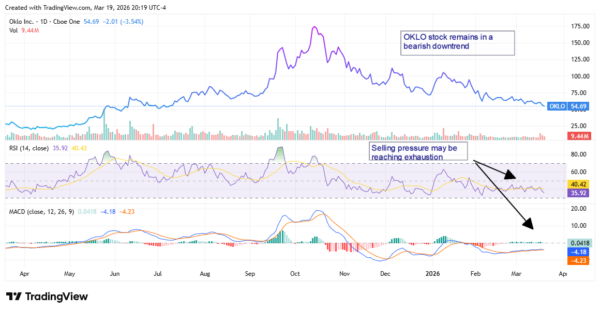
Volume on down days has begun to ease. The options market reflects the uncertainty: conviction is thin across the chain, with neither puts nor calls showing aggressive positioning that would signal a high-confidence directional bet from institutional traders. Any meaningful recovery is likely to be gradual, with significant overhead resistance between $70 and $100, representing prior support that has turned into resistance. Patience is the operative word.
Small Modular Reactors Are a Developing Story
Oklo is a high-conviction story wrapped in high uncertainty. The structural case for small modular reactors is compelling and increasingly backed by real commercial agreements, institutional capital, and favorable policy winds. The company’s vertically integrated model, if it reaches commercialization, could prove to be a durable competitive advantage in a sector starved for integrated nuclear solutions.
But the path there requires regulatory approvals that have not yet been secured, technology deployments that have yet to be proven at commercial scale, and a balance sheet that — however well-funded today — will continue to shrink before the first dollar of revenue arrives. OKLO is a stock for investors with a long time horizon, a high tolerance for volatility, and the discipline to size a position accordingly.
Leave a Reply