Lululemon Athletica (NASDAQ: LULU) reported its fourth-quarter fiscal 2025 earnings this week, and by the raw numbers, the results were better than feared. Revenue came in at $3.6 billion, up 1% year-over-year and slightly ahead of consensus estimates. Earnings per share of $5.01 beat the $4.79 Wall Street had penciled in. Management called it a quarter where the company “achieved better-than-expected revenue and EPS” while staying “focused on driving progress against the company’s action plan.”
Table of Contents
So why is the stock hovering near its 52-week low of $156.64, off more than 50% from its high of $348.50 over the past year?
The answer lies not in the quarter that was, but in the year that’s coming. That includes a set of contradictions embedded in the company’s own narrative that investors can’t quite square away.
The Numbers Tell Half the Story
For all of fiscal 2025, Lululemon posted total revenue of $11.1 billion, up 5% year-over-year, or 7% excluding the calendar boost from a 53rd week in the prior year. Diluted EPS came in at $13.26, a 9% decline. International was the unambiguous bright spot — revenue there grew 24% on a constant-dollar basis — while the Americas segment was essentially flat, a stubborn and concerning trend for a brand whose domestic market remains its financial engine.
The company’s product innovation narrative held some credibility. Women’s revenue grew 7% (excluding the 53rd week), men’s 3%, and accessories 4%. Digital revenue accelerated to 9% growth. But store revenue was flat, and total comparable sales were up only 2% — a far cry from the growth rates that defined Lululemon’s golden years.
The Discount Paradox
The most telling — and troubling — element of the quarter may be what management said about pricing strategy. Lululemon acknowledged that promotional activity helped drive traffic and move inventory during the holiday period, an implicit admission that discounting worked. At the same time, management reaffirmed its goal of returning to a full-price selling model, with analysts noting that a “gradual return to full-price selling is anticipated to commence in the second quarter of fiscal 2026.”
This is where the narrative strains against itself. A brand built on the premise of premium pricing — of $128 leggings as aspirational staples — is caught between two uncomfortable truths: discounting works in the short term, but it erodes the brand equity that justified the premium in the first place. Returning to full-price selling while consumers are actively hunting for value is not simply a strategic pivot. It is a bet that the consumer environment will cooperate.
That bet is looking increasingly risky.
The Tariff Overhang
Lululemon’s pricing flexibility is further constrained by the tariff environment. The company’s supply chain, like much of the apparel industry, is deeply exposed to trade policy risk. Management’s own forward-looking statements acknowledge “changes to U.S. tariff and customs policy, including the elimination of the de minimis exemption” as a material uncertainty.
This matters because the road back to full-price selling is not just a branding decision — it is a cost decision. If tariff-driven input costs rise, Lululemon faces a difficult calculus: absorb the margin compression, pass costs along to consumers who have already demonstrated price sensitivity, or continue promotional pricing to maintain volume. None of those options is painless, and the fiscal 2026 guidance of $12.10 to $12.30 in earnings per share — which fell short of the Street consensus of $12.50 — suggests management itself is not expecting a clean recovery.
Wall Street Is Not Convinced
The analyst community’s reaction to earnings has been instructive. Rather than a post-beat rally, the response has been a broad wave of price target reductions. Stifel cut its target to $176 from $210 while maintaining a Hold rating, citing the company’s inability to leverage its cost structure at current growth rates. Evercore ISI trimmed its target to $175 from $215. Wells Fargo went further, lowering its target to $150 — below where the stock is trading today. Goldman Sachs and UBS both trimmed their targets as well, to $184 and $189, respectively.
The consensus price target still sits between $217 and $225, implying meaningful upside from current levels. But that number is increasingly disconnected from where the most recent, post-earnings targets are landing. When analysts who cover a company daily set targets at or below the current share price, the consensus figure becomes a historical artifact rather than a forward-looking guide.
Adding to the uncertainty is the governance vacuum at the top. The company is without a permanent CEO, and founder Chip Wilson has publicly warned prospective candidates that the board is “unfit” to support visionary leadership. Jefferies analyst Randy Konik summarized the bear case bluntly: “…no CEO, founder dislikes the board, product remains off-base, company culture in tatters.” Until a credible leader is named, the strategic roadmap remains murky.
The Options Market Sees Downside Risk
The options chain heading into and out of earnings reinforces the cautious read. With LULU trading around $164, the most active strikes on the March 20 expiration are heavily skewed toward puts — the $160 put, the $155 put, and the $150 put carrying far more open interest than comparable calls. The implied volatility across the chain is running in the 134% to 141% range, which reflects the market’s expectation of continued price swings rather than a calm consolidation.
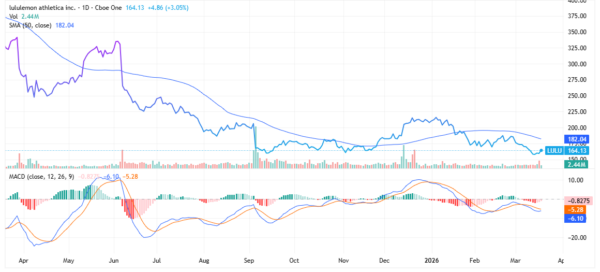
The 50-day moving average, currently at $182, sits well above the current price, and the MACD on the daily chart remains in negative territory with a bearish configuration — the signal line and MACD line both below zero, and the histogram printing red. There is no clear technical catalyst for a reversal without either a fundamental change in business momentum or a broader market bid.
A Consumer Story With Cracks Forming
Underlying all of this is a macro backdrop that is becoming less forgiving by the week. The holiday season — typically Lululemon’s best quarter — delivered a beat, but only a modest one. As the calendar turns to 2026 and the seasonal tailwinds fade, the question is whether the US consumer can sustain discretionary spending on premium athletic apparel in an environment of elevated rates, persistent inflation in essential goods, and growing uncertainty about employment and growth.
Lululemon is, at its core, a consumer confidence story. Its products are high-quality and genuinely loved, but they are also genuinely optional. When wallets tighten, $128 leggings tend to migrate from the “necessity” column back to the “treat” column. The company’s flat Americas performance throughout fiscal 2025 suggests that migration may already be underway.
The Verdict: Bottom Possible, Upside Uncertain
There is a reasonable case that the worst of the selling is behind LULU. The stock has shed more than half its value from peak, trades at a price-to-earnings ratio around 11 — historically cheap for a brand of its caliber — and the $1.6 billion buyback authorization provides a floor of sorts. International momentum is real, and product newness is improving.
But the upside case requires a convergence of favorable outcomes that are far from guaranteed: a new, credible CEO, a smooth return to full-price selling, a cooperative consumer environment, manageable tariff impact, and a stabilization of the core US business. That is a long list of conditions to check simultaneously. Until more of those boxes are ticked, LULU may be a stock that stabilizes around current levels without offering the kind of recovery that justifies a meaningful position increase.
The bottom may be forming. The ceiling, for now, remains hard to find.
Leave a Reply