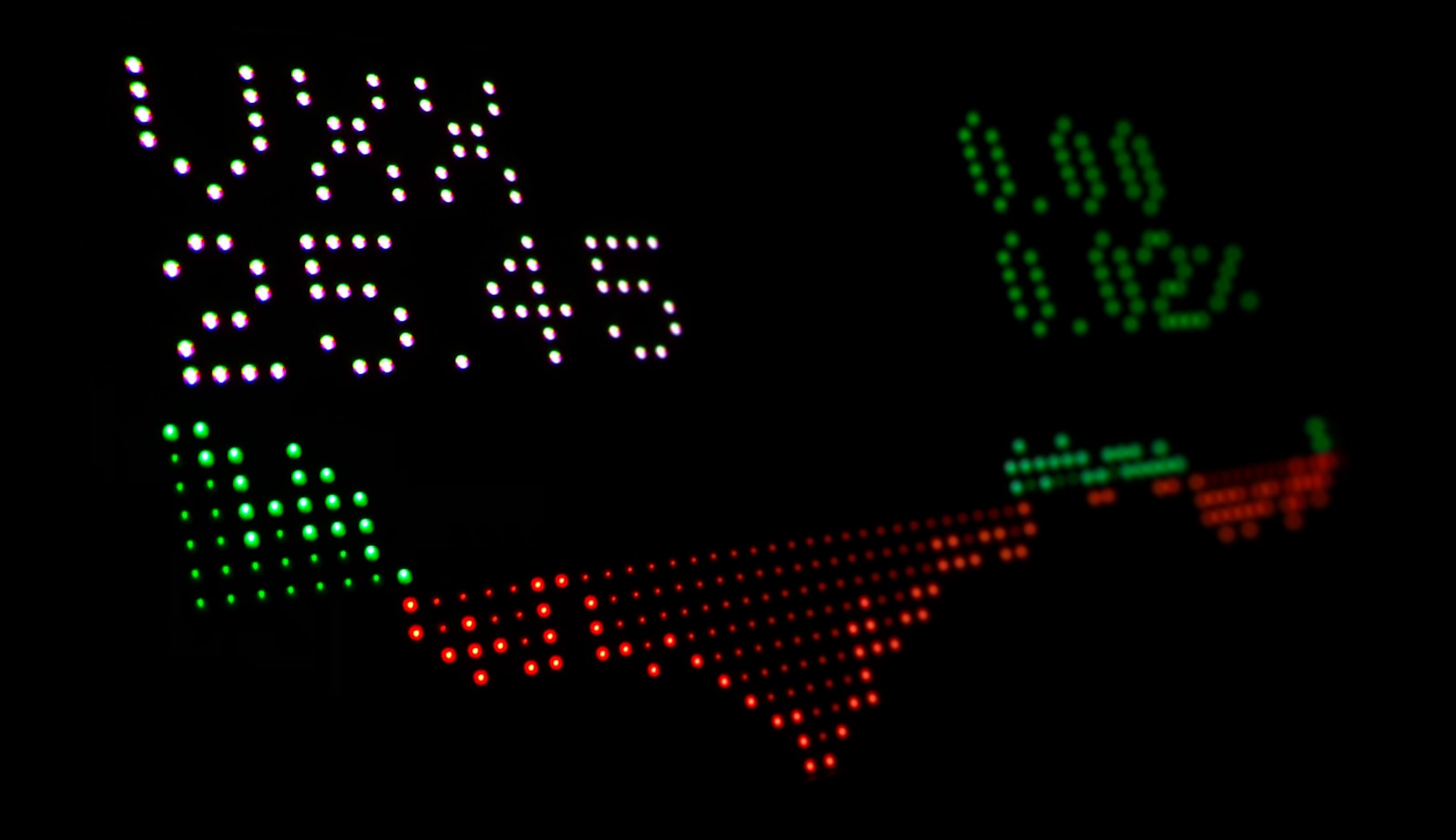
Keep an eye on the stretched CBOE Volatility Index (CBOE: VIX). At 26.33, the VIX is now challenging October 2025 trade war highs. However, this time, it’s uncertainty about the joint United States and Israel military campaign against Iran that is driving volatility higher.
Table of Contents
For one, the conflict appears to be widening. Drones hit the U.S. embassy in Riyadh. The State Department ordered evacuations at facilities in Bahrain, Iraq, and Jordan. Hezbollah attacked Tel Aviv. And there are concerns about how long Gulf states can keep themselves safe from Iranian attacks. Plus, President Trump just said the conflict could continue for another four weeks, which raises uncertainty, which markets hate.
In addition, “Market anxiety ratcheted higher overnight amid concerns that a decapitated and leaderless Iranian government and military will execute a prolonged retaliatory response aimed at sowing chaos throughout the region by targeting key economic and energy infrastructure for weeks to come,” said Adam Crisafulli of Vital Knowledge, as quoted by CNBC.
Until there’s clarity, markets could slip even more. Except for oil, which could easily gush higher.
Eventually, the Situation Will Cool Off
This too will pass. It’s easy for investors to say, but harder to internalize in volatile markets. However, right now, even though tensions are sky-high, the VIX is telling us that fear is too hot. And when the temperature goes down in the Middle East, we’ll be offered an opportunity on the short side of volatility.
In fact, if you look at the VIX dating back to early 2022, you can see that with every spike, RSI, MACD and Williams’ %R tell us when the VIX is likely to pivot lower. We saw that happen in April 2025, December 2024, August 2024, April 2024, October 2023, March 2023, October 2022, September 2022, and also in May 2022. Each time the VIX peaked with those three indicators, buying calls on the DIAs, QQQs and the SPY typically paid off well.
One of the best ways to trade an overheated fear gauge is by jumping into inverse VIX ETFs, which move higher when the VIX moves lower.
Take Advantage of Volatility With These ETFs
Here are two of the top ETFs to consider when the VIX moves lower:
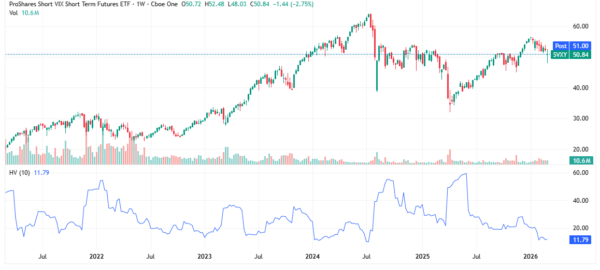
The ProShares Short VIX Short-Term Futures ETF (BATS: SVXY) seeks daily investment results, before fees and expenses, that correspond to one-half the inverse (-0.5x) of the daily performance of the S&P 500 VIX Short-Term Futures Index, as noted by ProShares.com.
Specifically, the fund tends to profit from decreases in the expected volatility of the S&P 500, as measured by the prices of VIX futures contracts. The S&P 500 VIX Short-Term Futures Index has historically been less volatile than the VIX but significantly more volatile than the S&P 500. The fund has an expense ratio of 0.95%.
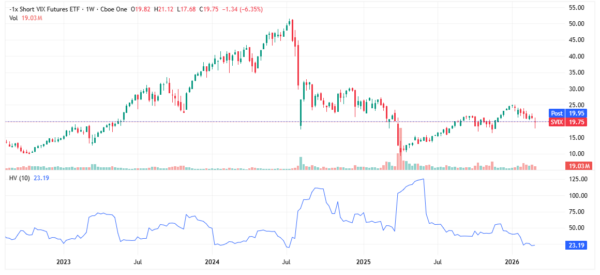
Another option is the -1x Short VIX Futures ETF (BATS: SVIX), which is an inverse VIX-linked ETF that seeks to provide daily investment results, before fees and expenses, that correspond generally to the Short VIX Futures Index, as noted by VolatilityShares.com.
Simply put, as the VIX drops, the SVIX ETF rises. The inverse is also true. That’s why the SVIX is down 13.4% in the 30 days ending March 3.
Make Volatility Your Friend
Right now, the headlines are full of doom and gloom. Geopolitical tensions are rising with uncertainty, oil is reacting by gushing higher on fear of what’s happening in the Strait of Hormuz, and the VIX is elevated. That combination naturally makes investors uneasy.
But seasoned investors know something important: volatility is emotional. It spikes when uncertainty rises — and it falls when clarity returns. It doesn’t stay elevated forever.
When volatility stops rising on bad news, that’s often the first sign that panic is burning out.
If the VIX begins to roll over, history suggests markets may stabilize and potentially rebound.
That’s when some of the greatest opportunities tend to appear — not when fear is building, but when it starts to fade. For now, patience matters. Let the fear spike. Let the technical signals develop. And be ready to act when conditions begin to normalize.
As Warren Buffett has said, “A climate of fear is your friend when investing; a euphoric world is your enemy.” Or, as we learned from Baron Rothschild, “Buy when there’s blood in the streets, even if the blood is your own.” His family is now worth $400 billion because of that, by the way.
Leave a Reply