
FedEx Corp. (NYSE: FDX) stock had a positive week, finishing with a gain of just over 1.5% after the company’s solid Q3 2026 earnings report. In addition to beating estimates on the top and bottom line, FedEx raised its fourth-quarter and full-year guidance despite the emerging threat of higher fuel prices.
Table of Contents
We live in a world where investors want instant reaction and, sometimes, hot takes after a company reports earnings. However, as FedEx shows, it’s often prudent to let an earnings report sit for a few days. That’s particularly true of a company that is more than tangentially impacted by geopolitical events as well as a headline-driven U.S. economy.
For example, on Feb. 18, the day before FedEx reported, FDX stock dropped nearly 3% in the afternoon after remarks from Federal Reserve chair Jerome Powell. Not only did the Fed not lower interest rates, but Powell also said the Fed hasn’t ruled out a rate increase. But after the company’s earnings report, FDX stock climbed approximately 4.5% before pulling back, ending the week in sympathy with a broader sell-off in stocks.
That means as a new trading week starts, FedEx is pretty much back where it started. But where does it go from here?
Network 2.0 is Progressing
Interestingly, the idea of where FedEx stock will go from here is based on the company’s progress in efficiently moving packages. At the core of that answer is the company’s Network 2.0 initiative. This is an overhaul of the company’s Ground and Express Networks with the goal of strengthening the company’s competitive position by:
- Improving pickup and delivery processes
- Trimming costs
Network 2.0 is part of FedEx’s broader DRIVE transformation — a multi-year effort to improve the efficiency with which FedEx picks up, transports, and delivers packages in the U.S. and Canada.
Make no mistake; this is a cost-cutting initiative, but one that’s working. In the company’s fiscal third quarter, it announced that 35% of eligible volume is now routed through approximately 400 Network 2.0 facilities. The company expects over $2 billion in cumulative savings by the end of 2027.
Revenue Growth Is Coming from the Right Places
One of the most encouraging elements of FedEx’s Q3 FY26 report was not just that revenue grew, but where that growth came from. Total consolidated revenue reached $24 billion, up 8% year-over-year, but the composition of that growth tells a more interesting story.
The Federal Express (FEC) segment drove the headline number, posting revenue of $21.2 billion, a 10% increase from the same quarter a year ago. Critically, nearly half of FEC’s revenue growth was driven by B2B services — the same trend seen in the prior quarter — signaling that FedEx is successfully moving up the value chain.
The company is deliberately targeting high-margin verticals, including healthcare, automotive, data centers, and aerospace. These are part of the company’s deliberate commercial strategy to pursue customers whose shipping needs are complex, time-sensitive, and less price-elastic than standard consumer deliveries. FedEx is also deepening its expertise in healthcare logistics and pharmaceutical distribution, where quality governance and regulatory compliance create real barriers to entry for competitors.
On the B2C side, FedEx recently launched FedEx Returns+, an AI-powered digital tracking and returns product designed to improve visibility and communication between shippers and end customers. Early U.S. market reaction has been positive, with a planned European rollout in April. This matters because sticky, tech-enabled customer relationships make it harder for shippers to defect to lower-cost alternatives. The combination of high-margin B2B momentum and differentiated B2C tools gives investors a credible path to sustained, quality revenue growth.
What the Chart Is Telling Us
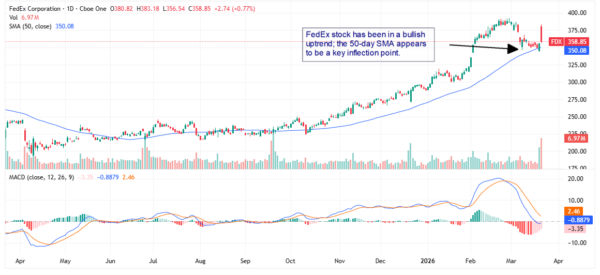
The FDX daily chart reflects a stock that has had a strong run but is now navigating a period of consolidation near a technically significant level. After trading mostly sideways through the spring and summer of last year, shares broke out meaningfully in the fall, ultimately reaching highs near the $390 range. That move higher was accompanied by expanding volume and a rising 50-day simple moving average (SMA), both hallmarks of a healthy trending advance.
Currently, FDX is trading around $358, sitting just above its 50-day SMA of $350. The 50-day SMA is a widely watched level for institutional investors, and the fact that the stock is holding above it, even after pulling back from recent highs, is a modestly constructive sign. However, the MACD tells a more cautious story. The MACD line sits at -3.35, while the signal line is at -0.88, suggesting that near-term momentum has weakened. The histogram, which recently showed a sharp negative spike on elevated volume, points to selling pressure that has not yet fully resolved.
The most recent volume bar is notably elevated compared to recent sessions, indicating the pullback has attracted attention. Whether that represents capitulation or the beginning of a deeper correction remains to be seen.
For investors watching FDX technically, the 50-day SMA near $350 is the line in the sand. A sustained close below that level would be a yellow flag. Conversely, a move back above $370 on strong volume would suggest the bulls have regained control, and the consolidation phase is ending.
How the FDX Stock Rally Can Run Out of Energy
Simply put, rising oil prices are the biggest near-term threat to FedEx. It’s actually a triple threat without many easy solutions.
A weak consumer is an obvious threat. Consumers have been remarkably resilient despite sticky inflation and interest rates that remain high, when compared to the extended period of near-zero rates that preceded it. However, there are already reports that higher gas prices could effectively erase any tax return benefits Americans get this season. That means higher fuel prices could fuel a goods recession.
Second, FedEx also faces higher fuel costs. That puts the company in a tricky situation. If they eat the costs, it will come at the expense of earnings. But if they pass the cost along, they risk adding to the burden on consumers.
The third threat is that if the conflict with Iran becomes protracted, it’s likely to trigger a broader economic slowdown. That means FedEx will see a slowdown from business customers, while consumers feel the pinch of higher fuel prices.
Investors also shouldn’t dismiss the threat from competition. This goes beyond United Parcel Service (NYSE: UPS) and now includes Amazon (NASDAQ: AMZN), which continues to expand its fleet and could take market share.
The Bottom Line on FDX
FedEx is a company in the middle of a genuine transformation, and Q3 FY26 showed that the transformation is producing real results. Network 2.0 is ahead of schedule, margins are expanding at the FEC segment for the sixth straight quarter, and management raised full-year guidance — all against a backdrop of global trade uncertainty and soft LTL demand.
The stock’s near-term path will depend heavily on macro factors outside FedEx’s control, particularly oil prices and consumer resilience. But for investors with a 12-to-18-month horizon, the risk/reward looks reasonable at current levels, particularly with the 50-day SMA offering a clear technical reference point. Watch the $350 level. If it holds, FDX remains a credible story.
Leave a Reply