It’s no secret that Exxon Mobil (NYSE: XOM) has been one of the strongest performers in the market this year, largely due to cynical reasons. Since the beginning of January, XOM stock has gained 25%, with much of the lift coming since the beginning of March. With the Trump administration greenlighting a military campaign against Iran — and the adversarial nation not backing down — there are great concerns about global energy supply disruptions.
Table of Contents
Basically, everything centers on the Strait of Hormuz. This narrow waterway represents the lifeblood of multiple economic powers, particularly in Asia. Without access to fossil fuels, it’s no exaggeration to say that these energy-exposed nations could quickly collapse. Given that Iran has threatened to effectively blockade the Strait, investments like XOM stock could potentially be lucrative.
However, a curious development has occurred recently. While there have been articles within the financial publication ecosystem pounding the table on XOM stock due to the supposed direct correlation between rising oil prices and equity valuations of integrated oil giants, reality presents a less optimistic picture.
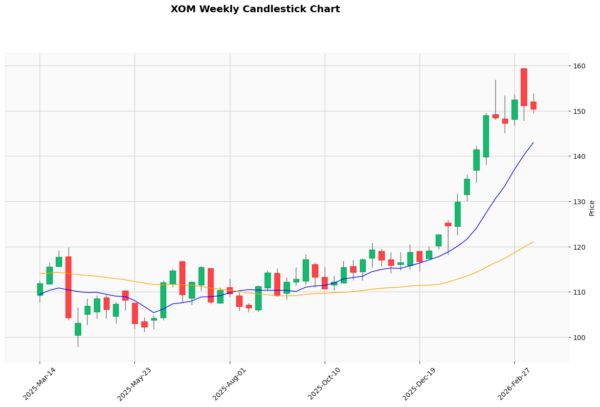
For example, in the past five sessions, XOM stock is down about 1%. Over the trailing month, the result is about the same. With bombs actually dropping instead of mere threats, one might imagine that the integrated energy sector would fly. Instead, valuations have stagnated, raising the obvious question: what gives?
Fundamentally, the disconnect may largely come down to a statistic known as the crack spread.
Why XOM Stock Isn’t the Sterling Buy You Might Think It Is
A common term in the energy market, the crack spread refers to the difference between the price of crude oil and the prices of petroleum products (such as gasoline) refined from it. This ratio serves as a key indicator of a refinery’s gross profit margin.
Unsurprisingly, due to the Iran war, the crack spread recently reached about $37 per barrel, which is historically elevated. Thanks to the oil price shock stemming from the conflict, refiners can charge more for their product, leading to an upswing in fuel prices across the nation. However, what’s important to note is that the crack spread has been declining daily by around $7.66.
Put simply, the profit margins among downstream specialists are getting squeezed relative to their spike highs. Now, this erosion of the spread isn’t as big of a problem if we assume that elevated oil prices become the new normal. That’s where the bullish thesis gets a little messy for the integrated oil giants.
If geopoliticsd stabilizes or has already passed peak crisis levels, the risk premium associated with the unusually elevated crack spread may simply evaporate. In other words, any form of substantive business flows regarding the energy market could result in a correction since there would be nothing fundamental upholding the risk premium.
Granted, if the Strait of Hormuz is blockaded or is otherwise severely impeded, then yes — the crack spread could skyrocket and that would mean XOM stock swings higher. But that’s not a foregone conclusion, which means investors ought to exercise prudence.
Another point is that energy demand can’t just rise based on restricted supply alone. If economic conditions weaken — at least in part because of the Iran war — then oil prices might sag due to consumers’ inability to pay.
Using the Inductive Approach to Trade Exxon Mobil Stock
Ultimately, the best mechanism to trade Exxon Mobil stock amid this tricky environment is pattern recognition. Right now, XOM is basically treading water after enjoying a strong rally. Ideally, we’d like to find similar analogs to help map a probabilistic path forward. However, defining patterns becomes like a messy Rorschach test.
Objectively, what we can say is that over the past 10 weeks, the number of positive and negative weekly candlesticks was split evenly, with the overall slope being positive. This is a very neutral setup and it also means that the security should respond in a distinct manner. In other words, if XOM stock was in the middle of a rally or if it just passed a corrective phase, the next 10 weeks should look different from a neutral starting point.
I don’t think this is a controversial point. If I started a race on neutral ground, my end result should be statistically different from starting uphill or starting downhill, assuming all other variables are the same. In the case of Exxon Mobil stock, I want to know what the odds are when specifically starting from a neutral position.
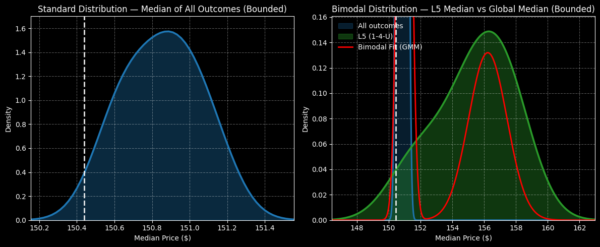
As it turns out, over the next 10 weeks, XOM should range between $148 and $156 under the aforementioned neutrality. However, the issue is that under aggregate conditions, XOM would be expected to range between $149.50 and $153.50. In other words, from a probabilistic standpoint, there isn’t much difference between betting randomly on Exxon Mobil stock or specifically betting on this particular neutral setup.
If anything, the fundamentals tied to the declining crack spread need to be the linchpin. Since margins are likely going to be compressed relative to recent peaks on the refinery side of the business, XOM stock is arguably at greater risk of witnessing a corrective spell in the immediate term.
Volatility Skew Tells the Rest of the Tale
On a final note, investors should consider Exxon Mobil’s volatility skew, especially for the May 15 options chain. Very briefly, the skew showcases the surface-area distortion of volatility space, allowing retail traders to better understand the risk positioning among smart money traders.
What does the skew indicate for XOM stock? Essentially, sophisticated market participants are prioritizing downside risk mitigation while being virtually flat regarding upside convexity. The name of the game here is to avoid giving up the deep pass and letting the opposing offense take up the small yardage.
With that being the case, it’s easy to see why the pros are hesitant about XOM stock. Yes, you could make the argument that call options are cheap on a volatility basis. But it just seems that the Iran narrative is a little bit too obvious, while the crack spread argument is much less discussed in the retail space.
If pressed for a specific trading idea, I’m eyeballing the 145/140 bear put spread expiring May 15. While the $140 strike falls outside the median expected range of Exxon Mobil stock, I believe the eroding crack spread may create a corrective pressure point that isn’t fully accounted for in the share price.
Leave a Reply