Dollar Tree (NASDAQ: DLTR) reported fourth-quarter fiscal 2025 earnings Monday morning that cleared Wall Street’s bar by a meaningful margin — and the stock responded accordingly, surging more than 6% as buyers stepped in after weeks of selling pressure.
Table of Contents
Net sales climbed 9% year over year to $5.45 billion. Comparable-store sales rose 5%, driven by a 6.3% increase in average ticket. Gross margin expanded 150 basis points to 39.1%. Adjusted diluted earnings per share came in at $2.56, topping the consensus estimate of roughly $2.53.
The beat matters less, however, than the setup heading into earnings. Dollar Tree had sold off sharply in the days preceding the report, pulled down in sympathy with Dollar General’s cautious 2026 guidance issued March 12. Dollar General’s shares tumbled nearly 8% after the company’s tepid outlook sent a chill through the broader retail sector. Ollie’s Bargain Outlet added further noise to the discount retail narrative. Investors weren’t waiting around to find out if Dollar Tree would echo the same softness.
They didn’t have to wait long. Dollar Tree is a fundamentally different business from Dollar General, serving more suburban and affluent zip codes, and its results reflected that distinction sharply. The question now is whether Monday’s bounce is a sustainable re-rating or a relief rally with a ceiling already built in.
The answer likely lies somewhere in between — and it circles back to a broader story that has been quietly unfolding for two years: the bifurcation of the American consumer, and the confusion it’s creating for investors trying to read the discount retail sector.
The Stock Was Primed for a Beat
The selloff ahead of earnings looked overdone even before Monday’s open. Dollar Tree shares had dropped to around $107, well below the 50-day moving average of $125.92, as investors lumped it in with the more rural-facing Dollar General. That’s a category error.
In 2025 alone, a quarter of Dollar Tree’s new stores opened in areas where median household incomes exceed $100,000, and shoppers earning over $100,000 made up 60% of the chain’s 3 million new customers in the latest quarter. That is not the same customer base that Dollar General serves in rural America.
The earnings deck reinforced this. Multi-price items — those above the legacy $1.25 price point — now represent roughly 16% of sales. About 5,300 stores have been fully converted to the multi-price format. Discretionary same-store sales rose 6.2%, outpacing consumables at 3.6%, a sign that the chain is successfully extracting higher-margin purchases from shoppers with room to spend.
The Family Dollar divestiture, completed in July 2025, stripped out the drag that had clouded Dollar Tree’s financials for years. The company is now a cleaner story, and the results are beginning to reflect that clarity.
Technical Analysis: A Bounce Below Resistance
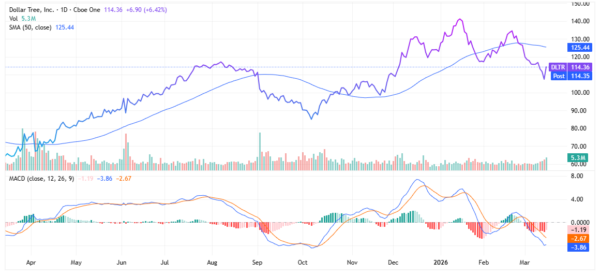
The chart tells a story that should temper near-term enthusiasm. DLTR peaked near $142 in early January before a sustained slide that carried the stock below $108 by last week. Monday’s +6% pop brings shares back to approximately $114 — still well below the 50-day moving average of $125.44 shown on the chart.
The MACD indicators remain deeply negative, with the MACD line at -3.86 and the signal line at -2.67. That configuration suggests the trend has not reversed — it has paused. Volume on Monday’s session was elevated, which is encouraging, but the stock faces a significant overhead supply zone between $120 and $130, where sellers who bought during the November-January rally may look to exit.
The average analyst 12-month price target currently sits around $136 implying roughly 19% upside from current levels. Truist, which carries a Buy rating with a $156 target, described Dollar Tree as having “significant earnings growth potential” as recently as March 9. That target gap is real, but closing it will require the stock to first reclaim the 50-day moving average convincingly.
A cautious read: this is a stock that bounced off deeply oversold levels on good news. That’s constructive, but it doesn’t automatically mean the downtrend has ended.
What Could Go Wrong: The Consumer Isn’t One Thing
The discount retail space is sending contradictory signals precisely because the American consumer is no longer one cohesive entity. After-tax wage growth was just 0.6% in February for lower-income households, compared with 4.2% for higher-income ones — the largest gap Bank of America has recorded since it began tracking the metric.
Dollar General’s cautious 2026 guidance reflects pressure on its rural, lower-income core. Dollar Tree’s suburban, higher-income mix insulates it somewhat, but it is not immune. Dollar General noted that sales growth from higher-income consumers softened noticeably in February amid a broader early-quarter slowdown — a dynamic that could affect Dollar Tree too if trade-down spending fades.
Dollar Tree’s own 2026 guidance was deliberately conservative: comparable-store sales growth of 3% to 4% and adjusted EPS of $6.50 to $6.90. That guidance was based on the tariff landscape as of February 19, 2026. Any escalation in import costs — Dollar Tree sources heavily overseas — could compress margins in ways the current outlook doesn’t fully capture.
Traffic remained a sore spot in Q4, down 1.2% even as ticket size surged. Winning on average ticket while losing footsteps is a dynamic that works until it doesn’t.
Conclusion: A Better Story, But Patience Required
Dollar Tree’s Q4 results confirmed what the selloff had obscured: this is a fundamentally improved business, not a Dollar General clone with a different logo. The multi-price strategy is working, margins are expanding, and the balance sheet is clean following the Family Dollar exit.
But the stock’s technical picture still argues for patience. The consensus target implies meaningful upside, and analysts have been moving their numbers higher. Getting there, however, requires reclaiming resistance levels and a consumer environment that stays cooperative. For long-term investors, the story is intact. For traders looking for a quick follow-through, the chart says wait for confirmation.
Leave a Reply