Dick’s Sporting Goods (NYSE: DKS) delivered what, on the surface, looked like a strong fourth quarter — record-setting sales for the DICK’S namesake banner, with comparable store sales rising 3.1% in Q4 and 4.5% for the full year, driven by growth in both average ticket and transaction volume. But by the time the regular session was underway on Thursday, the initial enthusiasm had largely faded, leaving shares up less than 1% after briefly spiking more than 5% in pre-market trading. The story of why encapsulates exactly where DICK’S stands right now: a core business that is executing well, an ambitious acquisition that is still proving itself, and a guidance number that Wall Street found wanting.
Table of Contents
The Quarter in Numbers
For the fourth quarter ended January 31, 2026, net income fell 57.3% to $128 million, or $1.41 per diluted share, compared to $300 million, or $3.62, in the prior-year period. Net sales surged 59.9% to $6.23 billion from $3.89 billion — a jump that reflects the first full contribution from Foot Locker, which closed in September 2025. The comparison is flattering on the top line, but the bottom-line contraction is hard to ignore, and it’s by design: DICK’S Sporting Goods has been deliberately absorbing the costs of transforming its newly acquired competitor.
For the full year 2025, net income was down 27.1% to $849 million, or $9.97 per diluted share, versus $1.17 billion, or $14.05, in 2024. Full-year net sales rose 28.1% to $17.22 billion from $13.44 billion. On a non-GAAP basis, which strips out integration charges, the Dick’s-only business earned $14.58 per share — a figure that underscores just how solid the legacy operation remains.
Guidance Misses the Mark
The market’s lukewarm response to an otherwise respectable report traces directly to the 2026 outlook. DICK’S Sporting Goods guided for full-year 2026 adjusted earnings per share of $13.50 to $14.50, below the $14.67 analysts had been expecting. Comparable sales growth for the DICK’S business is projected at 2.0% to 4.0%, while pro forma comparable sales growth for the Foot Locker business is expected to come in between 1.0% and 3.0%. The consolidated top-line outlook also fell short of the Street’s consensus, which had been looking for revenue of around $21.77 billion.
The guidance shortfall is not entirely a surprise. As a major importer of footwear and apparel, largely sourced from Southeast Asia and China, DICK’S is navigating a tariff environment that remains uncertain in 2026. Analysts at Williams Trading have flagged that tariffs are expected to pressure margins and complicate pricing strategies, noting that hard goods and equipment categories — much of which is sourced from China — face particular cost headwinds. That dynamic is likely contributing to some conservatism in management’s profit forecast, even as the underlying consumer demand picture for sporting goods remains healthy.
The Foot Locker Transformation: Early Signs of Progress
The more compelling part of Thursday’s narrative is what DICK’S Sporting Goods is building with Foot Locker. Executive Chairman Ed Stack struck an optimistic tone on the acquisition, noting that the company is “encouraged by what we’re seeing” with the Fast Break initiative and the evolution of its 11-store Foot Locker pilot, which the company plans to rapidly scale in 2026, Stack also said the “clean out the garage” effort — a reference to DICK’S aggressive work to clear out unproductive inventory and reset Foot Locker’s merchandising and operations — has positioned the banner to go on offense heading into back-to-school season.
CEO Lauren Hobart pointed to a non-GAAP operating margin of over 11% for the year at the DICK’S banner and expressed confidence that the combined company is “perfectly positioned at the intersection of sport and culture.” The company replaced Foot Locker’s previous leadership team after the acquisition closed, installing Ann Freeman to lead Foot Locker North America.
Management has previously projected $100 million to $125 million in cost synergies over the medium term, primarily from procurement and direct sourcing efficiencies, and expects the acquisition to be accretive to EPS in fiscal 2026 on an adjusted basis.
Store Expansion Continues
While managing the Foot Locker integration, DICK’S is not letting up on its own store growth strategy. The company opened 16 House of Sport and 15 DICK’S Field House locations in 2025 and plans to open approximately 14 additional House of Sport stores and 22 new DICK’S Field House locations in 2026. House of Sport, DICK’S experiential retail format featuring climbing walls, batting cages, and a curated sneaker experience, has been central to the company’s effort to make its stores destinations rather than transactional spaces — a key competitive moat in an era when online alternatives continue to grow.
The Investment Case: Undervalued in Transition
For investors willing to look through the near-term noise, the setup for DKS is arguably more interesting than today’s modest stock move suggests. Analysts maintain a consensus average price target of $244.05 on the stock, with Morgan Stanley’s most recent target of $260 implying roughly 24% upside from current levels. Across 19 analysts covering the stock, the consensus rating is “Buy” with an average price target of $248.53, representing approximately 20% upside from current prices.
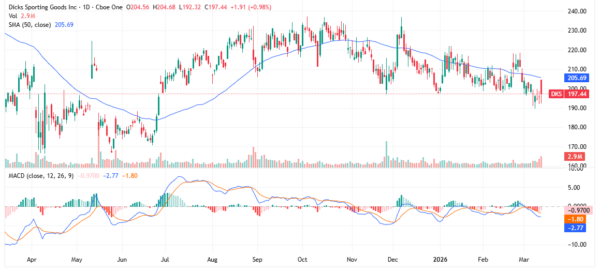
The bull case rests on several pillars: a core DICK’S business that is growing comps and expanding margins, a Foot Locker transformation that is still in its early innings but showing signs of traction, and a store expansion playbook that is differentiating the company in physical retail. The risks — tariff headwinds, integration execution, and a cautious consumer in a slowing macro environment — are real, but they appear well understood by the market at this point and may already be largely reflected in a stock trading well below its 50-day moving average of $205.69.
The company’s Board also authorized a 3% increase in the quarterly dividend to $1.25 per share, bringing the annualized rate to $5.00. That’s a signal of management’s confidence in the business’s cash generation even as integration spending remains elevated.
DICK’S Sporting Goods is, in many ways, a stock in search of a catalyst. The Foot Locker cleanup is proceeding, the core business is healthy, and the store portfolio is evolving in a differentiated direction. The market’s muted reaction today likely reflects impatience more than fundamental concern. For investors with a longer time horizon, that impatience may represent an opportunity.
Leave a Reply