
Dell Technologies (NYSE: DELL) delivered a blockbuster Q4 FY26 earnings report on February 26, 2026, sending DELL stock surging more than 20% in the days that followed. The numbers were hard to argue with: record quarterly revenue of $33.4 billion, up 39% year-over-year, powered by a 342% spike in AI-optimized server revenue to $8.95 billion. Full-year revenue reached $113.5 billion, up 19%, capping what the company called “a defining year in its history.”
Table of Contents
Non-GAAP diluted EPS for the year climbed to $10.30, up 27%, while the company projected $50 billion in AI server revenue for FY27 — more than double FY26’s output. For traders riding the post-earnings wave, the results were a gift. But for long-term investors now staring at a chart that has broken above key resistance levels on massive volume, the more pressing question is whether the rally has already priced in the good news — and then some.
Dell Is the New Normal for the AI Trade
The post-earnings pop in DELL stock is a perfect encapsulation of a pattern that has become routine in the AI infrastructure trade: strong results, a sharp spike, and then a grinding reassessment. Dell has become a bellwether for enterprise AI spending, and its Infrastructure Solutions Group clearly tells that story.
ISG revenue surged 73% year-over-year to $19.6 billion in Q4 alone, with the AI server backlog exiting the quarter at $43 billion. New AI-optimized server orders in Q4 hit $34.1 billion, a single-quarter record. Dell also noted its opportunity pipeline continued to grow even after converting more than $34 billion in new orders throughout the year.
The FY27 guidance further validates the demand thesis: total revenue projected at approximately $140 billion, with ISG growing at a mid-forties pace and AI server revenue specifically expected to double to $50 billion. That kind of forward visibility is rare and reflects genuine, broad-based demand from hyperscalers, sovereign AI initiatives, and enterprise customers finally moving from AI pilots to production deployments.
Yet that visibility is also what creates the dilemma for investors. Much of this optimism is now baked into the share price. Long-term investors who have held DELL stock through its transformation would be wise to consider trimming into this strength rather than chasing the move.
The Dividend May Be the Long-Term Investor’s Anchor
One argument for staying patient is the dividend. Dell raised its annualized payout to $2.52 per share — a 20% year-over-year increase — and committed to growing it at 10% or better annually through FY30. Since initiating the dividend in FY23 at $1.32 annualized, the payout has compounded at a 17.5% CAGR, a track record that commands respect from income investors.
Combined with a buyback program that repurchased shares at more than twice the prior year’s pace — reducing the fully diluted share count roughly 14% from FY22 to FY26 — Dell is running a shareholder-friendly capital return program that rivals higher-profile tech names. The company returned $7.5 billion to shareholders in FY26 alone, against a commitment to return more than 80% of adjusted free cash flow over the long term. For investors who prefer to hold compounders, the dividend growth story alone may be reason enough to maintain a position in DELL stock even if the near-term price has run ahead of fundamentals.
Technical Outlook: Extended and Watching the Bollinger Bands
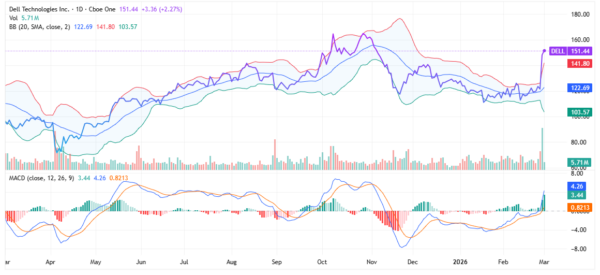
The DELL stock chart tells a cautionary story. As of March 2, 2026, DELL closed at $151.44 — well above both its 20-day SMA of $141.80 and the upper Bollinger Band, with the lower band sitting near $103.57. The sharp post-earnings vertical move has pushed the stock into technically extended territory, trading outside the upper band — a condition that historically precedes consolidation or a reversion toward the mean.
The MACD confirms short-term bullish momentum, with the MACD line at 3.44 — but the histogram has been widening rapidly, suggesting the move may be nearing exhaustion. Volume on the breakout was elevated at 5.71 million shares, a sign of institutional participation but also a signal that the bulk of the move likely belongs to the initial earnings reaction rather than a sustained grind higher.
A reversion toward the 20-day SMA near $141 or the midpoint of the Bollinger Band range near $122 would not be surprising. Either level would represent a healthier base for the next leg higher, assuming the fundamental thesis continues to deliver through FY27.
Challenges to the Thesis
The primary risk to Dell’s AI server momentum is gross margin pressure. AI-optimized servers carry structurally lower margins than traditional servers and storage, and Q4 made that plain: ISG operating margin came in at 14.8%, down 330 basis points year-over-year despite record revenue. Management guided FY27 operating income rates toward the lower end of their long-term framework.
Analyst concerns are also mounting over memory costs. DRAM and HBM pricing has been volatile, and sustained component cost increases could compress margins further even as revenue grows. Dell is a systems integrator, not a chipmaker — it relies on NVIDIA, AMD, and Intel for critical components, making it more exposed to supply-side cost cycles than some peers. Should memory inflation accelerate through 2026, earnings growth could slow even as the demand narrative holds, weighing on sentiment and the multiple.
Bottom Line: Take Some Profits, but Don’t Walk Away
Dell’s Q4 FY26 results were genuinely impressive, and the AI server demand cycle appears durable through FY27 and beyond. But a post-earnings surge of more than 20% has compressed the margin of safety for new buyers and created a natural rebalancing opportunity for long-term holders. The dividend growth story and $11.5 billion in adjusted free cash flow for FY26 make Dell stock worth keeping in a portfolio — but trimming into the technically extended setup while waiting for a healthier entry near $122–$141 is the more prudent path for investors with a longer time horizon.
Leave a Reply