Darden Restaurants (NYSE: DRI) is having a very good Thursday. The parent company of Olive Garden, LongHorn Steakhouse, and a portfolio of fine dining brands reported fiscal third-quarter 2026 results that beat Wall Street expectations on both revenue and earnings, and raised its full-year outlook. Shares responded in kind, rising roughly 2.67% to $206.07 at the time of writing — a notable move on a day when the broader market was in the red.
Table of Contents
Total sales for the quarter came in at $3.3 billion, representing 5.9% growth year-over-year. Same-restaurant sales grew 4.2%, a meaningful figure for a company of Darden’s scale. Adjusted diluted earnings per share from continuing operations reached $2.95, up from $2.80 in the same period last year. Adjusted EBITDA hit $578.7 million, compared to $558.5 million a year ago. The company also returned $300 million in cash to shareholders through dividends and buybacks during the quarter.
For the full year, Darden now guides for total sales growth of approximately 9.5% and same-restaurant sales growth of approximately 4.5%. Adjusted diluted EPS is projected to land between $10.57 and $10.67 — a range that includes roughly $0.25 from a 53rd fiscal week. Those are not the numbers of a company that is struggling.
The Business Is Firing on Multiple Cylinders
Every major segment contributed to the quarter’s results. Olive Garden, still Darden’s volume anchor, grew sales 4.7% year-over-year to $1.39 billion. LongHorn Steakhouse was the standout performer, posting 11.2% sales growth to $854 million — the strongest showing in the portfolio. Fine Dining, which includes Capital Grille, Ruth’s Chris, and Eddie V’s, grew 4.3% to $402 million.
Margin compression was modest and manageable. Restaurant-level EBITDA margin came in at 21.0%, down just 30 basis points versus the prior year. Food and beverage costs — the line item most sensitive to inflationary pressures — were 30.7% of sales. Labor improved by 20 basis points. Darden’s scale and procurement infrastructure have historically helped it better absorb commodity cost increases than its smaller peers, and that dynamic appears to be holding.
The company is also actively reshaping its portfolio. Bahama Breeze locations are being closed or converted, and the integration of Chuy’s continues. The preliminary fiscal 2027 outlook calls for 75 to 80 new restaurant openings and approximately $850 million in capital spending — a signal of confident long-term investment.
Analysts and Institutions Are Paying Attention
Wall Street’s response to today’s report has been constructive. Analysts are raising price targets following the beat-and-raise, reflecting growing confidence in Darden’s ability to sustain traffic and margin performance in a choppy consumer environment. Institutional ownership remains strong, consistent with the kind of steady, dividend-paying large-cap that attracts long-duration holders.
Speaking of the dividend, it deserves more attention than it typically gets. At an annual payout of $6.00 per share and a long-term target dividend payout ratio of 50% to 60% of earnings, Darden’s income story is durable. The company’s long-term framework also targets total shareholder return of 10% to 15% annually, combining EPS growth with dividend yield. For income-oriented investors, that combination is worth noting.
Share repurchases add another layer. Darden targets a 1% to 2.5% annual reduction in share count through buybacks, contributing to EPS growth over time. It is a disciplined capital return framework, and management has largely delivered on it.
What the Chart Is Telling Us
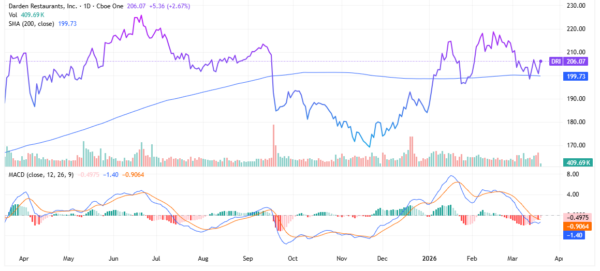
The technical picture for DRI is constructive but nuanced. The stock is trading at $206.07, comfortably above its 200-day simple moving average of $199.73 — a positive sign that the longer-term trend remains intact. The 200-day has been rising steadily, which reflects the gradual rebuilding of institutional confidence over the past several months.
However, the MACD indicator tells a more cautious story. The MACD line sits at -0.4975 with the signal line at -0.9064, and the histogram at -1.40, indicating that short-term momentum has been negative heading into today’s print. The stock had been drifting lower in the weeks leading up to earnings, which may have created a setup where a beat was more impactful than it might have been otherwise.
Today’s move on above-average volume — approximately 409,690 shares — on a down market day is a meaningful signal. Stocks that rally against a falling tape on high volume and fundamental catalysts often see follow-through. The key level to watch is whether DRI can hold above the 200-day and build toward its prior highs near $220 from earlier in the cycle.
What Could Go Wrong
Darden’s portfolio is tilted toward the upper leg of the K-shaped economy. LongHorn, Capital Grille, Ruth’s Chris, and Eddie V’s are all drawing from consumers who, so far, have shown resilience. But that is precisely the risk. If the broader economy deteriorates — whether from sustained inflation, rising unemployment, or a pullback in consumer confidence among higher-income households — Darden’s traffic trends could soften quickly.
The commodities picture also warrants monitoring. Beef, which represents 25% of Darden’s food spend, faces high single-digit inflation in Q4. Seafood is projecting low double-digit inflation. The company has 80% weighted average coverage heading into the quarter, which provides a buffer — but not immunity. Darden is also navigating the Bahama Breeze wind-down and will face some noise in the reported numbers related to impairment charges and closure costs through the end of fiscal 2026.
Bottom Line: A Quality Name Earning Its Premium
Darden is not cheap on an absolute basis, trading at roughly 21x forward earnings. But relative to the restaurant sector average of approximately 26x — per Yardeni Research, it represents a discount for a company with this level of brand diversity, operational discipline, and capital return consistency. Compared to the S&P 500’s roughly 19x average, the modest premium seems justified given the beat-and-raise quarter on the table today.
For investors watching DRI, the story is straightforward: a well-run, diversified restaurant operator delivering results, returning cash, and trading at a reasonable price relative to its peers. The risk is macro. The reward, if the consumer holds, may just be on the menu.
Leave a Reply