
The recent tech sell-off has hit many high-growth names hard, and Trade Desk (NASDAQ: TTD) stock is no exception. As fear spreads through the market, investors are once again faced with a familiar question: Is this decline a warning sign or a buying opportunity?
Table of Contents
Market sell-offs often create disconnects between price and value. When sentiment turns negative, whether due to macro concerns, rising rates, or company-specific issues, stocks can fall faster than fundamentals deteriorate. For disciplined investors, these periods can offer compelling entry points into high-quality companies at discounted prices.
Why Market Fear Creates Buying Opportunities
When negative headlines hit—whether it’s economic uncertainty, rising interest rates, or company-specific concerns—investors tend to rush for the exits. This creates selling pressure that can push stock prices well below their intrinsic value. In these moments, price and value can temporarily disconnect. That’s where opportunity begins.
For investors, one of the most effective ways to use fear to your advantage is to focus on high-quality companies experiencing temporary setbacks. These are businesses with strong fundamentals—consistent revenue growth, solid balance sheets, and durable competitive advantages—but whose stocks have declined due to short-term concerns rather than long-term deterioration.
Trade Desk Stock: What’s Behind the Recent Sell-Off?
Shares of The Trade Desk have pulled back sharply, leaving many investors wondering whether the story is broken or if this is simply a temporary setback.
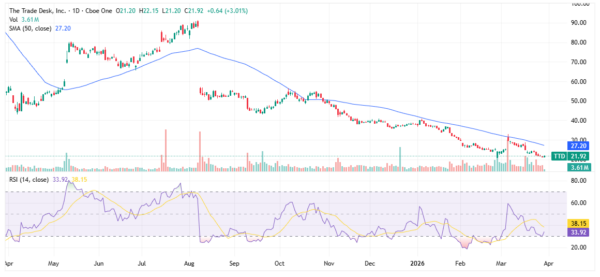
After all, the company has been dealing with slower revenue growth, rising competition, and guidance that failed to excite the market. At the same time, its position in the digital advertising ecosystem—especially in the fast-evolving streaming TV space—has come under increased scrutiny. Add in the growing influence of artificial intelligence, and the pressure only intensifies, with giants like Google and Instagram competing aggressively for advertising dollars.
All of that said, the recent weakness may be creating an opportunity.
OpenAI Partnership Could Be a Game-Changer
One of the more interesting developments is the possibility of a partnership between OpenAI and The Trade Desk. Reports suggest the two have discussed ways to scale advertising within ChatGPT. If a deal actually comes together, it could be a meaningful shift. Instead of being seen as an experimental platform, ChatGPT could evolve into a legitimate advertising channel—one that marketers can easily plug into using existing tools.
That matters because it would put ChatGPT in direct competition for ad budgets that currently flow to search and social platforms. For Trade Desk, being part of that infrastructure could open the door to a whole new stream of demand.
Insider Buying Signals Confidence
Another encouraging sign comes from inside the company. CEO and founder Jeff Green recently purchased $150 million worth of TTD stock, putting his money where his mouth is. And while it doesn’t eliminate risk, it does send a clear message: the person with perhaps the best understanding of the company’s trajectory believes the stock is undervalued.
AI Is Already Embedded in Trade Desk’s Platform
In addition, according to Green, the company has been building its AI and machine learning capabilities for more than a decade, long before the current wave of excitement. Today, those technologies are embedded across its platform, enhancing everything from ad bidding to predictive analytics. Its systems can process millions of ad opportunities per second, analyzing thousands of variables in real time to match advertisers with the right audiences.
In other words, AI isn’t new to Trade Desk.
Risks to Watch Before Buying Trade Desk Stock
That doesn’t mean the risks disappear. Growth has slowed, competition remains fierce, and the long-term shape of AI-driven advertising is still uncertain. Investors will need to watch closely to see how the company adapts as the landscape evolves.
Key Catalysts That Could Drive a Rebound
Even so, several potential catalysts could drive renewed momentum. These include the possibility of an OpenAI partnership, a recently authorized $500 million share buyback program, and the significant insider purchase by its CEO. Taken together, these factors suggest that while uncertainty remains, the current pullback may offer an attractive entry point for patient investors.
Leave a Reply