
Dollar stores have long been considered a defensive pocket of retail, but the latest earnings from Dollar General (NYSE: DG) and Ollie’s Bargain Outlet (NASDAQ: OLLI) are testing that narrative for investors. Both companies delivered fundamentally solid reports, yet their stocks sold off as the market focused less on backward-looking strength and more on what comes next.
Table of Contents
Dollar General posted a sharp rebound in earnings and healthy same-store sales growth, but tempered its 2026 outlook, triggering a pullback even after a sizable beat on consensus estimates. Ollie’s extended its track record of double‑digit revenue and earnings growth and issued upbeat guidance, yet the stock remains in a broader downtrend as investors reassess valuation after a strong multi‑year run.
For investors who view dollar stores as a reliable safe haven in a slowing macro backdrop, these reactions raise a key question: is the bull case for the space still intact, or is the market signaling that even value-focused retailers are no longer immune to multiple compression and guidance haircuts? The answer may come down to how much of the bad news is already in the price, particularly for Dollar General, and whether Ollie’s can grow into its premium multiple while sentiment searches for a durable bottom.
Dollar General: Guidance Over Growth
Dollar General’s quarter looked strong on the surface. Net sales grew 5.9% year over year to about 10.9 billion dollars, with same-store sales up 4.3% and operating profit more than doubling versus a year earlier period that included significant impairment and closure charges. EPS of 1.93 dollars handily topped expectations in the 1.60–1.61 dollar range, reflecting progress on shrink mitigation, margin expansion and store productivity initiatives.
Yet the stock fell roughly mid‑single to high‑single digits after the release as management’s 2026 guidance called for slower growth relative to the rebound pace implied by Q4. The company signaled more modest same‑store sales gains in the low‑single digits and continued investment in stores and labor, a combination that tempers near‑term operating leverage even as the business normalizes.
For investors, the setup looks like a classic “good quarter, cautious guide” scenario. The fundamental trajectory is improving, but after a strong rebound in the shares over the last year, the market is demanding clearer evidence that 2026 and beyond can sustain mid‑cycle growth without further margin surprises. That dynamic helps explain why Dollar General sold off despite delivering the kind of defensive earnings print that historically would have supported the safe‑haven narrative.
Ollie’s: Growth Story Versus Valuation
Ollie’s continues to put up the kind of topline and earnings growth that most brick‑and‑mortar retailers would envy. Fourth‑quarter net sales rose about 17% year over year to roughly 779 million dollars, with comparable sales up 3.6% and full‑year comps around 3.7%. EPS increased to 1.39 dollars in the quarter and 3.89 dollars for the year, both up mid‑teens percentages, supported by healthy traffic and a still‑solid closeout merchandise pipeline.
Management’s outlook calls for approximately 2% comp growth, gross margin around 40.5%, and adjusted EPS between 4.40 and 4.50 dollars on about 3.0 billion dollars in net sales, all ahead of prior Street expectations. The guide underscores that Ollie’s remains a structurally attractive off‑price growth story, with unit expansion and margin strength driving earnings power higher.
However, the stock’s challenge has been less about execution and more about valuation and sentiment. Shares are trading below their 52‑week high and have been in a broader downtrend even as analysts have reiterated bullish views and lifted price targets following the report. That suggests investors are wrestling with how much upside remains from here, given the premium multiple, especially in a market that is becoming more selective about paying up for defensive growth. Ollie’s appears to be searching for a bottom rather than breaking out, even as the underlying numbers stay solid.
Technical Picture: Oversold Versus Drifting
From a technical standpoint, Dollar General and Ollie’s are telling slightly different stories. Dollar General’s sharp post‑earnings pullback comes after a period of strong performance, and indicators such as RSI and short‑term momentum suggest the stock is entering or approaching oversold territory. Given the magnitude of the drawdown versus the scale of the earnings beat and still‑positive comp trends, the price action looks more like a sentiment reset on guidance than a deterioration in fundamentals.
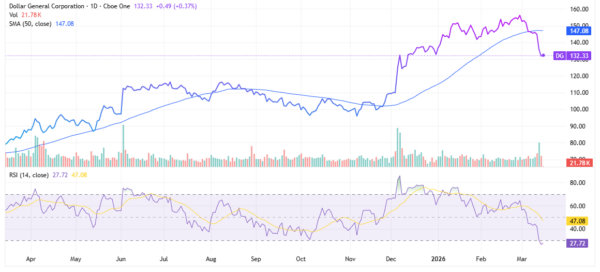
That kind of setup is often where longer‑term investors start to re‑underwrite the story: if guidance proves conservative and operational improvements continue, there is room for a mean‑reversion trade as the market recalibrates expectations. In other words, Dollar General’s chart is now offering a potential entry point for investors willing to look through near‑term noise in outlook commentary.
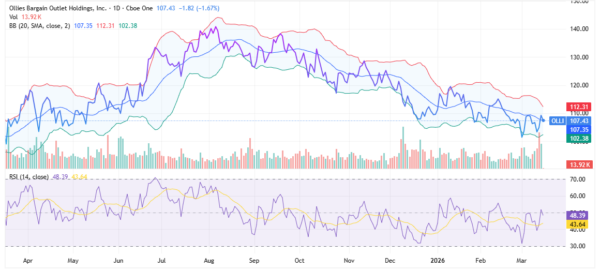
Ollie’s chart is more ambiguous. The stock has been in a sustained downtrend and now sits well below its prior peak, even after bouncing on the latest results. Volatility around earnings has not yet translated into a decisive trend reversal, suggesting the market is still digesting the valuation and growth trade‑off. Technically, that looks more like a bottoming process than a clear oversold snapback, which may argue for a more patient, phased‑in approach rather than an aggressive buy‑the‑dip stance.
Dollar Stores: Dented, Not Broken
For now, the bull case for dollar stores is dented but not broken. Dollar General is executing better operationally, but the stock is hostage to cautious guidance and macro worries about the low‑income consumer, creating a potentially attractive entry point as oversold conditions emerge. Ollie’s remains a high‑quality growth story whose main headwind is valuation rather than fundamentals, yet its prolonged downtrend shows that “defensive growth” is no longer guaranteed a premium multiple.
For investors, dollar stores may still play a role as relatively safe havens versus more discretionary retail, but the recent action makes clear that earnings quality alone is not enough. Position sizing, entry points, and time horizon now matter more than the simple assumption that value‑oriented formats will automatically outperform when consumers trade down.
Leave a Reply