
With the U.S.-Iran war continuing to intensify, $200 oil is a possibility. And unfortunately, you won’t want to see pump prices if that happens.
Table of Contents
At this point, it all depends on what happens next in the U.S.-Iran war and with the blocked Strait of Hormuz. It’s not ideal to have 20% of the world’s daily oil consumption held in limbo. Making it worse, Middle East countries are cutting oil production. Kuwait announced precautionary cuts to oil production because of “Iranian threats against safe passage of ships through the Strait of Hormuz,” as quoted by CNBC.
Adding to the supply side woes, Iraq’s production has fallen apart. Production from its three main oilfields fell 70% to 1.3 million. Prior to the war with Iran, those fields were pumping out 4.3 million bpd. This is happening because Iraq is running out of storage space, which ties back to the Strait of Hormuz.
According to Iran, “If you can tolerate the price of oil exceeding $200 per barrel, continue this game,” added Ebrahim Zulfikari, spokesperson for the Hatem al-Anbiya Central Headquarters of the Islamic Revolutionary Guard Corps (IRGC), as quoted by AzerNews.
Some would say that’s just blustery talk from a country that is under attack. However, a defiant Iran just ramped up its strikes, hitting three cargo ships in the Strait of Hormuz. It will be interesting to see what happens next with oil, with the International Energy Agency proposing the largest release of oil reserves in its history to bring down crude prices.
As noted by The Wall Street Journal, “The release of 400 million barrels of oil would more than double the agency’s biggest prior release, when IEA member countries in 2022 put 182 million barrels on the market after Russia launched its full-scale invasion of Ukraine, the officials said. The proposal was circulated at an emergency meeting of energy officials from the IEA’s 32-member countries on Tuesday. Countries are expected to decide on the proposal on March 11. It would be adopted if none object, but even one country’s protests could delay the plan.”
So What’s the Best Way to Trade the News
Investors can always jump into Exxon Mobil (NYSE: XOM), Chevron (NYSE: CVX), and Occidental Petroleum (NYSE: OXY). However, if you want to diversify at a lower cost, ETFs offer good value. In fact, here are three energy ETFs pushing higher with oil that we’ve been pounding the table over for months.
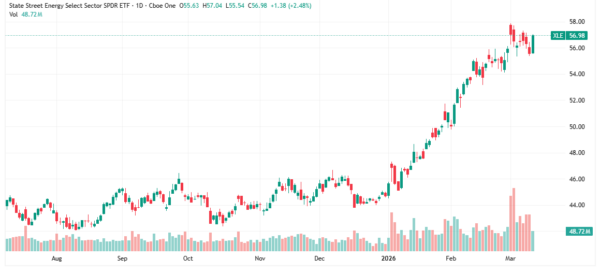
SPDR Energy Select Sector ETF (XLE)
With an expense ratio of 0.09%, the SPDR Energy Select Sector ETF (NYSEARCA: XLE) provides exposure to companies in the oil, gas and consumable fuel, energy equipment and services industries, as noted by State Street SPDR. Since February 20, the XLE ETF has run from about $54.50 to a high of $55.60 so far.
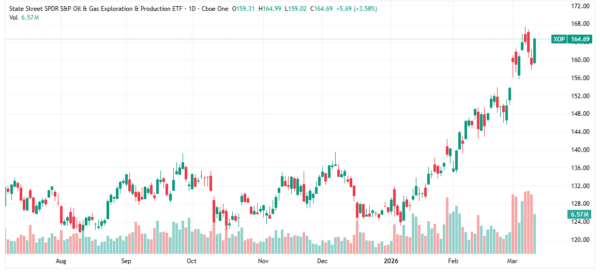
SPDR S&P Oil & Gas Exploration & Production ETF (XOP)
With an expense ratio of 0.35%, the SPDR S&P Oil & Gas Exploration & Production ETF (NYSEARCA: XOP) provides exposure to 51 oil and gas companies in the exploration and production segment of the S&P TMI, which comprises the following sub-industries: Integrated Oil & Gas, Oil & Gas Exploration & Production, and Oil & Gas Refining & Marketing, as noted by State Street SPDR. Since February 20, the XOP ETF has run from about $150 to $159.
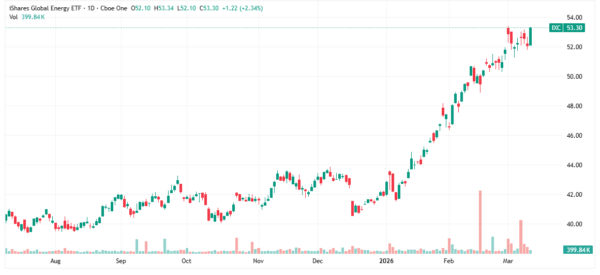
iShares Global Energy ETF (IXC)
With an expense ratio of 0.40%, the iShares Global Energy ETF (NYSEARCA: IXC) seeks to track the investment results of an index composed of global equities in the energy sector. Some of its 50 holdings include Exxon Mobil, Chevron Corporation, BP PLC, Total SA, and EOG Resources. Since February 20, the IXC ETF has run from about $50.60 to $52 so far.
Energy ETFs Offer a Simple Way to Play the Oil Spike
For investors looking to capitalize on rising oil prices without betting on a single company, energy ETFs provide a straightforward solution. Funds like XLE, XOP, and IXC offer diversified exposure across major oil producers, exploration companies, and global energy giants that tend to benefit when crude prices surge.
If tensions in the Middle East continue and the Strait of Hormuz remains under threat, oil markets could stay volatile with an upward bias. In that environment, broad-based energy ETFs allow investors to participate in the upside while reducing company-specific risk. For traders expecting oil to remain elevated—or even spike to extreme levels—these funds may remain among the most efficient ways to gain exposure to the energy sector.
Leave a Reply