
Flutter Entertainment (NYSE: FLUT) delivered a mixed bag in its Q4 and full-year 2025 earnings report — one that sent shares tumbling further into oversold territory. But for contrarian investors willing to look past near-term turbulence, the Flutter Entertainment stock story may be more compelling than today’s price suggests.
Table of Contents
The parent company of FanDuel, the dominant U.S. sportsbook operator, posted full-year revenue of $16.4 billion, up 17% year-over-year, and adjusted EBITDA of $2.85 billion, up 21%. Yet a full-year net loss of $407 million, driven largely by a $556 million non-cash impairment charge tied to India’s sudden ban on real-money gaming, dominated the headlines. The stock was already down roughly 43% year-to-date before this report. Oppenheimer recently cut its price target from $280 to $210, and yet even that reduced target implies roughly 60% upside from current levels. That gap demands an explanation.
The bull case isn’t blind optimism. It’s built on a specific catalyst, durable competitive advantages, and the kind of technical setup that tends to attract value-oriented institutional money. Here’s the case and the caution.
The World Cup Catalyst: Flutter’s Global Edge
The single most underappreciated factor in the Flutter story right now may be the 2026 FIFA World Cup, which will be hosted primarily in the United States this summer. For most U.S. sportsbook operators, soccer remains an afterthought. For Flutter, it is a core business.
Flutter is headquartered in Dublin, Ireland, and operates a portfolio of market-leading brands across Europe, Latin America, Asia-Pacific, and the U.S. Brands like Paddy Power, Betfair, Sky Bet, and Sisal have spent decades cultivating deeply loyal soccer-betting customer bases.
These are not casual fans. They are experienced, high-frequency bettors who treat the World Cup as one of the premier wagering events on the calendar. With the tournament now on U.S. soil, Flutter is uniquely positioned to cross-pollinate its international customer base with its fast-growing FanDuel platform, potentially capturing both European bettors and newly converted American soccer fans within a single ecosystem.
CEO Peter Jackson noted in his shareholder letter that the expanded 2026 tournament represents “a critical global focal point for customer acquisition,” and that Flutter’s global footprint, including the U.S., makes it “the best-placed operator to capitalize on this global opportunity.” The Q2/Q3 2026 window could provide a meaningful revenue and EBITDA inflection point that current guidance does not fully capture.
Prediction Markets: Threat or Trojan Horse?
One of the more nuanced debates surrounding Flutter right now is whether the rise of prediction markets — platforms like Kalshi and Polymarket — is quietly cannibalizing FanDuel’s sportsbook business. Management was emphatic that it isn’t. Their internal review, combining third-party deposit data, app download trends, and customer behavior analysis, estimated the handle growth impact at “low single-digit percentage points.”
Skeptics will note that management is hardly a disinterested party here. But the Venn diagram framing is useful: the two customer bases overlap, but they are not identical. Traditional sportsbook bettors are motivated by sports knowledge and competitive odds. Prediction market participants skew toward politically and economically curious users who may have never placed a sports bet. These are more additive than substitutive audiences.
More importantly, Flutter has launched its own prediction market platform — FanDuel Predicts — now live in 18 states, including California, Texas, and Florida. Management’s more provocative argument is that prediction markets may actually accelerate sports betting legalization in holdout states by normalizing regulated wagering culture. If that thesis proves correct, Flutter’s addressable market expands.
Technical Outlook: Oversold and Approaching a Decision Point
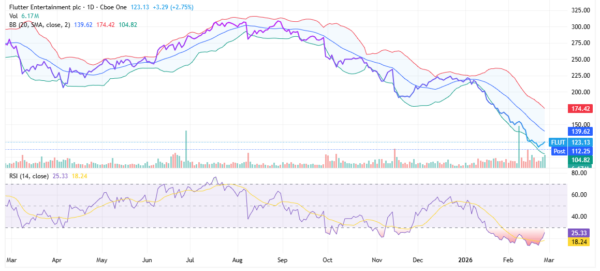
The chart tells a stark story. FLUT has been in a persistent downtrend since peaking near $325 in the summer of 2025, shedding roughly 62% of its value to the current range near $123. The stock is trading well below both its 20-day moving average ($139.62) and its upper Bollinger Band ($174.42), with the price pressing against the lower band near $104.82.
Perhaps most notably, the 14-period RSI has fallen to approximately 18 — deep into oversold territory by any conventional measure. Historically, RSI readings below 30 in high-quality, large-cap stocks with intact business fundamentals tend to mark exhaustion points for sellers rather than the beginning of further collapse. Volume was elevated at 6.17 million shares on earnings day, suggesting a capitulation-style flush rather than a steady bleed.
This does not mean the bottom is in. Oversold stocks can remain oversold. But for investors with a 12-to-18 month horizon and a willingness to leg into a position rather than commit all at once, the risk/reward calculus near the 52-week low has shifted meaningfully.
What Could Go Wrong: The Bear Case
The bears are not without ammunition. Free cash flow collapsed 57% to $407 million for the full year, and the leverage ratio surged from 2.2x to 3.7x following acquisitions of Snai, BetNacional, and the buyout of Boyd Gaming’s 5% FanDuel stake. Debt now stands at $12.3 billion. In a higher-for-longer rate environment, that is not a comfortable balance sheet.
The U.S. sportsbook environment is also more challenging than management expected. Handle growth moderated sharply in Q4 2025, a trend that has continued into 2026. The recycling effect — where bookmaker-friendly sports results reduce customer activity — is real and difficult to predict. UK tax increases (iGaming rates nearly doubling to 40% in April 2026) will create a $235 million adjusted EBITDA headwind even after mitigation. And the India exit, while a one-time impairment, removes a meaningful long-term growth market from the portfolio. FanDuel Predicts is an exciting option, but the company plans to absorb $250–$300 million in adjusted EBITDA losses to build it out.
Conclusion: A Contrarian Setup Worth Watching
Flutter Entertainment is not a stock to chase recklessly. The near-term headwinds are real, the balance sheet has more leverage than ideal, and visibility into the U.S. handle recovery timeline is limited. But the setup — deep oversold conditions, a World Cup catalyst on the horizon, institutional ownership that remains robust, and a reduced Oppenheimer target that still implies 60% upside — makes FLUT worth serious attention from patient, risk-tolerant investors.
The smarter play is likely a scaled entry: a partial position now, with dry powder reserved for a potential further dip. If the World Cup delivers the revenue inflection this company’s global footprint is built for, the current price may look like the opportunity it appears to be.
Leave a Reply