
Weyerhaeuser Company (NYSE: WY) offers investors a leveraged way to play a potential U.S. housing recovery and a renewed upswing in lumber prices in 2026. With shares rebounding off 2024 lows and powerful momentum building into the new year, this timber REIT looks positioned for upside as the supply‑demand imbalance in U.S. housing collides with still‑elevated but stable lumber prices.
Table of Contents
The U.S. continues to face a significant housing shortage, with estimates ranging from roughly 2.8 million to as many as 6 million units needed to close the gap between supply and demand. That structural deficit supports multi‑year demand for new construction once mortgage rates ease further, which could begin to unlock more activity later in 2026. As one of the largest private timberland owners in North America, Weyerhaeuser is tightly linked to that cycle through its exposure to lumber and wood products.
Lumber prices, while well off their 2021–2022 peaks, have largely normalized and traded within a broad range over the past three years, with framing lumber starting 2026 at about 872 dollars per thousand board feet after a volatile but ultimately modest year‑over‑year increase. That combination of normalized pricing and embedded operating leverage means a housing‑driven demand surge in late 2026 could translate into outsized earnings growth for Weyerhaeuser relative to today’s bearish expectations.
Housing Tailwinds Favor Timber REITs
The underlying housing backdrop remains supportive for a long‑term bullish case. The U.S. Chamber of Commerce and AEI estimate that the U.S. faces an ongoing housing shortfall of several million units, with particular pressure on younger buyers and key job‑growth markets. Separate estimates from major banks suggest a need for roughly 2.8 million additional units just to meet current demand, underscoring the depth of the supply deficit.
Even though higher mortgage rates slowed single‑family starts in 2023–2024, construction activity has begun to stabilize, and forward‑looking policy work is focused squarely on expanding supply. As mortgage rates gradually move lower and household formations continue, a catch‑up phase in new construction becomes increasingly likely in 2026. Timber REITs like Weyerhaeuser are direct beneficiaries of that trend, as higher housing starts translate into greater demand for structural lumber, panels, and related products.
Lumber Prices Poised for Upside
Lumber has already undergone a full boom‑and‑bust cycle, with prices spiking more than 200 percent above pre‑pandemic levels before retracing, then stabilizing at a new, higher plateau. Framing lumber prices climbed through most of 2024 and 2025, with July 2025 prices more than 10 percent above the prior year and October 2025 still up double‑digits year over year despite a modest quarterly pullback.
As of January 2026, framing lumber sits near 872 dollars per thousand board feet, down slightly from late 2025 but still above year‑earlier levels, reflecting both constrained supply and firm construction demand. Importantly, the industry continues to deal with mill curtailments and closures in Canada and the southern U.S., a dynamic that can amplify any demand‑side recovery into sharper price moves. If housing starts reaccelerate later in 2026, a renewed spike in lumber is very plausible, which would directly support Weyerhaeuser’s pricing power and margins across its timber and wood products operations.
Valuation, Technical Setup, and Trade Ideas
On valuation, Weyerhaeuser currently trades around 26.80 dollars per share with a trailing price‑to‑earnings ratio near 58 times, reflecting still‑depressed earnings after a cyclical downturn. Forward estimates imply a multiple closer to the high‑30s, which, while elevated versus traditional REITs, is more reasonable when viewed against the company’s history of boom‑and‑bust earnings tied to commodity cycles. As expectations normalize and analysts’ consensus price target in the low‑30s becomes the new anchor, the stock could re‑rate higher if housing and lumber surprise to the upside.
Technically, the daily chart shows Weyerhaeuser turning the corner decisively. Price has surged from the low‑22 area in December to the high‑26s in mid‑January, reclaiming both the 50‑day and 200‑day moving averages, which currently sit near 23.0 and 25.0 dollars, respectively. The MACD has crossed bullishly above the zero line with widening histogram bars, confirming a momentum shift from accumulation into an emerging uptrend.
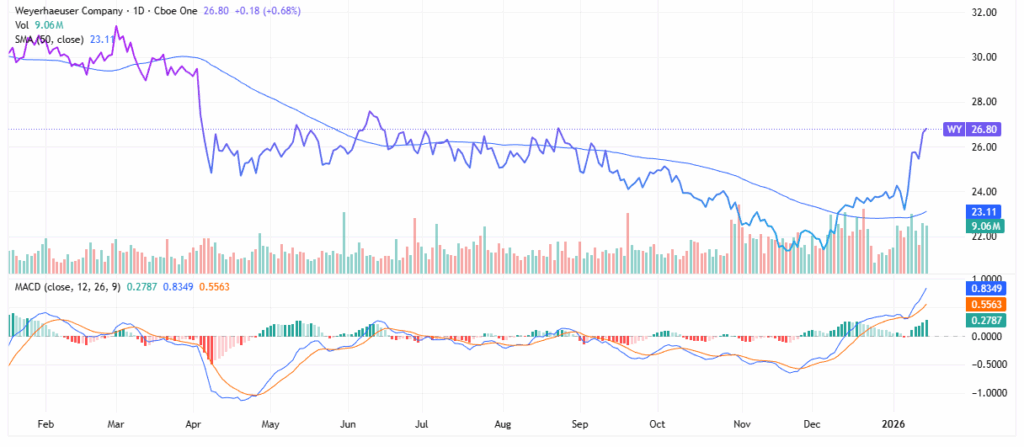
For aggressive traders, an initial entry in the 26–27 range with a stop just below the rising 200‑day moving average—around 24.50–24.75—offers a favorable way to participate in the breakout while respecting recent support. A first upside target would be a retest of the 2025 highs in the low‑30s, roughly in line with current analyst targets, with a stretch objective toward the upper‑30s if lumber prices spike and earnings power inflects. More conservative investors might wait for a pullback toward the 25–25.50 zone, looking for the 200‑day to hold as support and MACD to remain positive before scaling in gradually.
Conclusion
Weyerhaeuser offers a compelling way to express a bullish view on a late‑2026 housing recovery and a potential second leg higher in lumber prices. With structural undersupply in U.S. housing, normalized but still elevated lumber, and a chart that has transitioned from downtrend to confirmed upside momentum, the risk‑reward skews attractively for patient investors willing to ride the next phase of the cycle.
Leave a Reply